

CHANGES IN THE CONTENT OF WATER, ORGANIC AND INORGANIC SUBSTANCES IN THE WINTERING WORKER HONEY-BEES APIS MELLIFICA CAUCASICA GORB.
tekst: Barbara Leźnicka, Janina Muszyńska, Krystyna Banucha, Zofia Stachera
Pszczelnicze Zeszyty Naukowe, Rok XXVIII, 1984 — Barbara Leźnicka, Janina Muszyńska, Krystyna Banucha, Zofia Stachera
strona 29PSZCZELNICZE ZESZYTY NAUKOWE Rok XXVIII Puławy 1984
1. Barbara Leźnicka, 2. Janina Muszyńska, 3. Krystyna Banucha, 4. Zofia Stachera
1.3.4. Department of Zoology and Ecology, University of Warsaw
- Institute of Pomology Bee Department, Puławy
INTRODUCTION
With the winter change of living conditions important alterations occur in the bodies of honey-bees. They are shown by the changes in such organs as the fat body and esophagus glands (Muszyńska, Bornus, 1981), as well as by the changes in the hemolymph of insects which may be observed in different periods of overwintering, and they pertain to the level of proteins (Tomaszewska, 1969), lipids and glucose (Tomaszewska, Czernichowska, 1976). The evidence for such phenomena is also provided by the results of the analyses of whole insects; they point out to the changes in the contents of glycogen and water (Parhon, 1905), and fresh and dry weight (Čerednikov, Matuškina, 1970; Akopian, 1978).
Muszyńska and Bornus (1981) have called attention to the fact, that the changes in the quantities of fresh and dry weight of alimentary canals, and also of water contained in them take a different form than in the remaining bee tissues. This information and the changes in the contents of glucose, glycogen, water and in dry weight direct our attention to the processes of osmotic regulation of the wintering insects and their mineral metabolism.
Bees continue feeding during the wintering period, however they neither remove the undigested food remnants, nor they excrete the superfluent products of nitrogen metabolism or the mineral salts taken with food. One can expect then, that the storage of the excess substances in the alimentary canal prevents an increase of their content in the remaing tissues of the organism. We have decided to determine, during the consecutive month of the wintering period, the contents of water,
strona 30and organic and inorganic substances in the bodies of whole bees, in alimentary canals and in the bodies after the exclusion of alimentary canals. The data obtained this way were also to help to ascertain whether the changes in the content of these substances both in the alimentary canal and in the food it contains, have an effect on their composition in the remaining tissues.
MATERIAL AND METHODS
Worker bees of six bee families (Apis mellifica caucasica Gorb.) were studied. The experiments were run during two successive wintering periods (1977/78 and 1978/79) from the formation of the autumn cluster until the final spring leaving of the winter cluster. The wintering periods differed from one another with regard to thermic conditions and snow precipitation (Table 1).
Table 1 Average air temperature and average snow precipitation in Puławy in the years 1977/78 and 1978/79 (according to informations obtained from IMGW (Institute of Meteorology and Water Management)
| Month | XII | I | II | III | IV | |
|---|---|---|---|---|---|---|
| Temperature (°C) | 1977/78 | —1,2 | —1,9 | —4,2 | +3,5 | +6,4 |
| 1978/79 | —3,8 | —5,8 | —5,4 | +2,7 | +6,7 | |
| Snow cover (cm) | 1977/78 | 11,0 | 9,0 | 28,0 | 5,0 | o |
| 1978/79 | 6,0 | 8,0 | 35,0 | 26,0 | 0 |
The experimental apiary was kept in Puławy under the control of the Bee Department, the Institute of Pomology. Bee families were placed in hives of the Dadant type and were prepared for the winter according to the recommendations of the Bee Department. The bees began the wintering period with equal strength. Data about the wintering and sampling periods of the insects are summarized in Table 2.
Worker bees were sampled once a month from the outer layer of
Table 2 Data on bees wintering and periods of sampling in the years 1977/78 and 1978/79
| Wintering period | Last autumn flight | First spring flight | Data of cluster leaving | Length of wintering period | Date of first sampling | Data of last sampling | Total number of sampling period | Number of bee families studied | Total number of analyses |
|---|---|---|---|---|---|---|---|---|---|
| 1977/78 | 20.XI. | 9.III. | 15.IV. | 145 | 28.XI. | 10.IV. | 5 | 6 | 2640 |
| 1978/79 | 20.XI. | 9.III. | 20.IV. | 159 | 7.XII. | 10.IV. | 5 | 6 | 2640 |
the cluster. Precautions were taken to prevent the overcooling of the nest nad the breaking of the cluster. Eeach time eighty insects were sampled. The contents of water and organic and inorganic substances were determined in three kinds of samples, forty, whole bees, forty bees, without the alimentary canals, and in forty alimentary canals including the food substance they contained. These samples will be subsequently referred to as: whole bees, tissues, and alimentary canals. The sizes of these samples have been considered (Muszyńska and Konopacka, 1974) sufficient for the statistical analysis of the dry and fresh weight contents of bees studied in summer. A sample of forty indivuduals had also turned out to be of a size large enough to determine in winter the fresh weight of alimentary canals and of bees without alimentary canals (Muszyńska, Bornus, 1981).
The water content was found from the difference between the fresh and dry weight of each specimen. Bees without alimentary canals were treated in the same manner. Because of their small weight, five alimentary canals were weighed simultaneously. Fresh weight was termined directly after sampling, and dry weight after drying at 65°C in a vacuum drier. The dry material was grinded in a porcelain mortar, dried again, and once more weighed with the accuracy to 0.01 mg, and next it was burnt during eight hours at 450°C. The ash thus obtained was weighed. The organic substance content was found from the difference between the dry weight and ash weight.
The results were statistically analysed with the variance method of R. A. Fisher and the significance of the differences observed was examined with the t-Duncan test.
RESULTS AND DISCUSSION
Water. Observations made during two successive wintering periods suggested, that the water content of the whole bee organisms and in the alimentary canals as well, was relatively high during winter months and it decreased following the spring flight (Table 3). The water content in tissues changed only slightly. Thus no periods of greater or decreased hydration could be distinguished.
Changes in the water content were determined from the calculations of all the statistically significant differences in the water quantity in samples studied during individual months of the wintering period. The number of these differences indicates the lowest changes in the water content in tissues and the highest changes in the alimentary canals (Table 4). This observation partains to both wintering periods. In winter of 1978/79 characterized by low temperatures (Table 1), the water content thus determined was greater than in winter 1977/78. Also higher were the differences between the maximal and minimal quantities of water in the perticular kinds of samples (Table 5)..
strona 32Table 3 Average water content (% fresh weight) and of organic and inorganic substances (mg/100 mg dry weight) in the organisms of whole beeds, in tissues (without alimentary canals) and in alimentae canals
| Component studied | Month | Whole bees: 1977/78 | Whole bees: 1978/79 | Alimentary canals: 1977/78 | Alimentary canals: 1978/79 | Tissues (without alimentary canals: 1977/78 | Tissues (without alimentary canals: 1978/79 |
|---|---|---|---|---|---|---|---|
| Water | XII | 70,14 d-g | 67,35 cd | 73,25 de | 68,69 cd | 69,28 c | 65,11 a |
| I | 70,97 fg | 71,66 g | 70,63 cde | 75,69 e | 69,20 c | 69,67 c | |
| II | 68,16 c-f | 70,66 efg | 70,92 cde | 84,38 de | 69,69 c | 67,23 abc | |
| III | 67,88 abc | 62,75 a | 65,77 bc | 57,30 a | 68,76 c | 65,84 ab | |
| IV | 63,94 ab | 66,24 bc | 58,05 a | 61,82 ab | 68,45 c | 67,74 bc | |
| Organic substance | XII | 95,05 b-e | 96,93 e | 95,30 b | 96,23 b | 96,60 c | 96,57 c |
| I | 95,85 b-e | 95,27 a-d | 95,80 b | 93,18 a | 95,77 bc | 95,87 bc | |
| II | 95,00 abc | 94,70 ab | 95,25 b | 93,28 a | 96,05 bc | 94,37 ab | |
| III | 95,88 b-e | 96,33 cde | 95,95 b | 96,80 b | 95,78 bc | 96,65 c | |
| IV | 96,65 de | 94,10 a | 96,98 b | 93,08 a | 95,22 abc | 93,57 a | |
| Inorganic substance | XII | 3,95 a-d | 3,27 a | 4,70 bc | 3,37 ab | 3,40 a | 3,43 a |
| I | 4,15 abc | 4,73 b-c | 4,20 ab | 6,82 d | 4,23 a | 4,13 ab | |
| II | 5,00 cde | 5,30 de | 4,75 bc | 6,72 d | 3,95 ab | 5,63 b | |
| III | 4,12 a-d | 3,67 abe | 4,05 ab | 3,20 ab | 4,23 ab | 3,35 a | |
| IV | 3,35 ab | 5,90 e | 3,02 a | 6,92 c | 4,77 ab | 6,43 b |
Data designated with the same letter do not differ significantly
If we compare the water content in samples obtained in the same months of the two wintering periods, it turns out that it was present in lower quantities in the tissues of bees studied in December and March of the winter with lower temperatures. The alimentary canals and whole bees were also less hydrated during March after a severe winter (Table 3). The decreased hydration of the insects, and the low water content in the alimentary canals which persisted until April, indicate that following a cold winter, the intestine was emplied already after the first spring flight. A different situation occurred following a mild winter, when in April the intestine contained less water in March (Table 3). This may indicate that the alimentary canals of bees were still full in March. The greater filling of an intestine, which results from an intensive feeding during a colder winter, would provide the probable impulse fo its relatively early emptying. This suggestion conforms to the research results of Free and Spencer-Booth (1958). Experiments of these authors have shown that bees take more food when the temperatures of the external environment are low.
Organic substance. During the successive months of the winter 1977/78 one could observe that the contents of organic substance in the bodies of whole bees, in tissues and in alimentary canals remained at a stable level. A different situation occurred in the winter of 1978/79. Both in whole bees and in alimentary canals, there was a considerable lowering of organic substance in January and February, when compared
strona 33with its amount in December. This phenomenon coincided with a considerable lowering of the ambient temperature (Table 1). The changes in tissues which were observed during this winter were interesting, namely, the amount of organic substance had changed very slowly from December until February (Table 3).
In the course of the severe winter, unlike during the mild winter, there was a greater change in the organic substance content in all the kinds of samples. This was evident from the numbers of the statistically significant differences in the quantity of that component (Table 4).
Table 4 Number of statistically significant differences in the contents of substances studied in Honey-bees
| Wintering period | Whole bees | Alimentary canals | Tissues | |
|---|---|---|---|---|
| Water | 1977/78 | 5 (1) | 5 (1) | — (—) |
| 1978/79 | 8 (3) | 7 (2) | 3 (2) | |
| Organic substance | 1977/78 | 1 (1) | — (—) | — (—) |
| 1978/79 | 5 (3) | 5 (3) | 5 (2) | |
| Inorganic substance | 1977/78 | 1 (—) | 1 (—) | — (—) |
| 1978/79 | 4 (3) | 8 (3) | 4 (2) |
Number of significant differences between successive months is shown in parenthesis (based on data in Table 3).
Especially conspicuous were the similar contents of organic substance observed in the tissues of bees examined during comparable months of the successive wintering periods which so considerably differed with regard to thermic conditions. Such comparison of the quantity of organic substance contained in the alimentary canals, revealed its substantial decrease during the coldest months of the severe winter (Table 3). The differences between the maximal and minimal quantity of organic substance were also greatest in the alimentary canals studied during the cold winter (Table 5).
Inorganic substance. In the winter of 1977/78 the inorganic substance content in tissues, alimentary canals and in bodies of whole bees remained unvariable (Table 3).
In January and February, the coldest months of the winter 1978/79 the quantity of inorganic substance in the alimentary canals had substantially increased. From December till February its amount in the tissues and whole bees had increased gradually, but in March it had suddenly diminished (Table 3).
During the colder winter there were greater differences between the highest and the lowest contents of inorganic substances in all kinds of samples, than during the mild winter (Table 5).
The quantities of inorganic substances in the tissues examined during the comparable months of the consecutive years were similar.
strona 34Table 5 Differences between the highest and the lowest quantity of miligrams of the substance studied in bees during the wintering periods of 1977/78 and 1978/79. These quantities show the content per 100 mg fresh weight (for water), and the content per 100 mg dry weight (for organic and inorganic substance)
| wintering period | whole bees | alimentary canals | tissues | |
|---|---|---|---|---|
| Water | 1977/78 | 7,0 | 12,6 | — |
| 1978/79 | 8,9 | 18,3 | 4.5 | |
| Organic substance | 1972/28 | 1,6 | — | — |
| 1978/79 | 2,2 | 3,8 | 3,1 | |
| Inorganic substance | 1977/78 | 1,7 | 2,0 | 1,2 |
| 1978/79 | 2,6 | 3,7 | 2,3 |
Only statistically significant differences are shown in the Table.
In the bodies of whole bees any differences were noted only after a flight, while the changes in the alimentary canals were very much pronounced. The quantity of this component had increased not only following the flight, but also during the coldest months of the severe winter (Table 3).
The variations in the content of water and organic and inorganic substances in the particular kinds of samples are shown graphically (Fig. 1). Only the significant differences between the values ascertained for neighbouring months of the wintering period have been considered. The lack of significant differences is illustrated by a horizontal line. Any significant increase or decrease in the values has been indicated by a corresponding rise or lowering of a curve according to the adopted scale. The results show, that in winter 1977/78 the quantities of water and organic and inorganic substances contained in the tissues remained unchanged. In the whole bees and alimentary canals, the content of organic and inorganic substances was unvariable, while the water content did not change but in April.
The winter season of 1978/79 was considerably different from the previous one. The March increase of organic substance observed in whole bees, in alimentary canals and in tissues, as well as the simultaneous decrease in the water and inorganic substance contents, might have been the consequence of an intensive intake of food, rich in organic componuds, although impoverished with regard to mineral salts and water. It is possible that water was lost through evaporation during flight.
Particularly interesting is the decline of the organic substance content at the time od low temperatures prevailing in January and February (Table 1). During the same period of the previous winter, the temperatures were higher, but the organic substance content both in whole bees and alimentary canals did not change. These different
strona 35reactions of the insects could be explained with the long known information, that the temperature in the centre of the winter bee cluster reaches 30°C (Gates 1914; Wilson, Milum 1927; Corkins 1930). The maintenance of such high temperature during a cold winter, or at least the preserving of relatively stable thermic conditions, requires large amounts of heat energy released in the process of cell respiration. This supposition is consistent with the experiments of Eskov (1977) who has documented that with the lowering of the ambient temperature down to —6°C, the honey-bees of the central Russian and Gruzinska races utilize more oxygen. This increased oxygen consumption is from 20 cm³/1 minute to 40 cm³/1 minute. A special function in producing heat energy have the thorax muscles which perform specific vibration movements (Roth 1965). The heat energy which is dispersed during the work of the muscles increases with the lowering of the ambient temperoture. According to Kronenberg and Heller (1982),
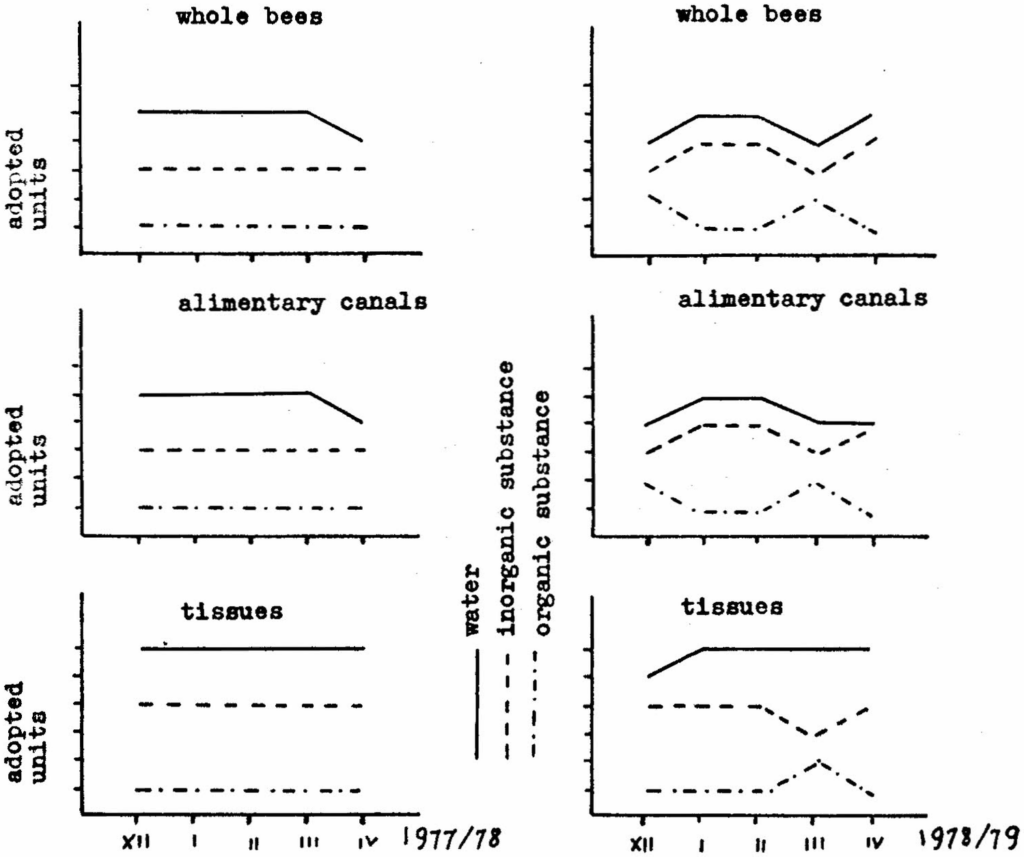
Fig. Occurrence of statistically significant differences the contents of water, organic and inorganic substances in the bodies of whole bees, in alimentary canals and in tissues (without alimentary canal), during the wintering periods 1977/78 and 1978/79
strona 36already at the ambient temperature of +10°C there is an increase in the amount of heat energy released by bees. An increase in the demand for heat energy may be related to the greater utilization of organic substance, which causes its considerable loss from the alimentary canal in spite od the fact, that the quantity of the food consumed might be even greater as was shown by the experiments of Free and Spencer-Booth (1958). It is interesting however, that the loss of organic substance observed in the tissues since December until February was slow (Table 3, the changes are not shown in fig. 1). It is possible therefore that the alimentary canal acts as a sort of barier which prevents the other tissues from a sudden disturbance of their chemical composition, which in this case would be the organic substance.
An additional substance which is being formed during the utilization of organic substance, especially of fats, is metabolic water. This may explain the increased hydration of the bodies of bees. Such a process however, may threaten with an increase of the temeperature of the freezing point for body liquids. The simultaneous rise in the quantity of inorganic substance may probably be considered as a defense reaction of the organism against this possibility.
CONCLUSIONS
The quantity of water and organic and inorganic substances contained in the bodies of worker bees (Apis mellifica caucasica Gorb.) undergoes changes during a period of overwintering. The greatest changes in the contents of these substances have been noted in alimentary canals. More frequent changes and with a greater range of fluctuations occur during winter with lower mean air temperatures. During a mild winter, no changes have been observed, within the temperature range studied, in the content of water and organic and inorganic substances in tissues (without alimentary canals).
We suggest that there is a relationship between the low temperature of the external environment and a greater utilization of the organic substance in alimentary canals, without disturbing the organic substance in tissues. It is likely that the resulting increase in the water content of the alimentary canal induces a reaction leading to an increase of inorganic substances, thus keeping the concentration of the alimentary canal contents at a required level. This reaction prevents against the rise of the freezing point temperature for body fluids. If these spupositions are correct, then one of the functions of the alimentary canal, would be, due to the transformations which occur within it, the maintenance of stability in the internal environment of the bee organism.
strona 37REFERENCES
Akopian N. M. (1978) — Nakoplienie żyra w organizmie pčeł zimoj. Pčelovodstvo (3):17.
Corkins C. L. (1930) — The metabolism of the honey-bee colony during winter. Bull. Wyo. Agric. Exp. Sta. 175:1—52.
Čerednikov A. W., Matuškina L. V. (1970) — K voprosu o fotoperiodyzmie. Pčelovodstvo 48(3):11—13.
Eskov E. K. (1977) — Relationship between the microclimte of bee-hive, the physiological state of bees and the environmental conditions. Zool. Zh. 56(6):870—881.
Free J. B., Spencer-Booth Y. (1958) — Observations on the temperature regulation and food consumption of honey-bees (Apis mellifera). J. Exp. Biol. 35(4):930—937.
Gates B. N. (1914) — The temperature of the bee colony. Bull. U.S. Dep. Agric. 96:1—29.
Kronenberg F., Heller H. C. (1982) — Colonial thermoregulation in Honey-Bees (Apis mellifera). J. Comp. Physiol. B. 148(1):65—76.
Muszyńska J., Konopacka Z. (1974) — Badania nad wielkością reprezentatywnej próby pszczół do analiz fizykochemicznych. Pszczeln. Zesz. Nauk. 18:183—194.
Muszyńska J., Bornus L. (1981) — Niektóre zmiany w organizmie pszczół robotnic z zimowego kłębu. Pszczeln. Zesz. Nauk. 25:15—30.
Parhon M. (1905) — Les echanges nutritifs chez les abeilles pendant les quatre saisons. Annales des Science naturalles Zoologie 9(1):1—58.
Roth M. (1965) — La production de chaleur chez Apis mellifica. L. Ann. Abeille 8(1):5—77.
Tomaszewska B. (1969) — The haemolymph proteins of the honey-bee (Apis mellifica L.) as found in normal individuals and in those from colonies affected by a disease. Zool. Pol. 19(4):469—493.
Tomaszewska B., Czernichowska A. (1976 — Badania nad poziomem glukozy i lipidów całkowitych w hemolimfie zimujących pszczół. Pszczeln. Zesz. Nauk. 20:203—208.
Wilson H. F., Milum V. G. (1927) — Winter protection for the honey-bee colony. Res. Bull. Wis. Agric. Exp. Sta. 75:1—47.
ZMIANY ZAWARTOŚCI WODY, SUBSTANCJIO RGANICZNEJ I NIEORGANICZNEJU ZIMUJĄCYCH PSZCZÓŁ ROBOTNIC APIS MELLIFICA CAUCASICA GORB
Barbara Leźnicka, Janina Muszyńska, Krystyna Banucha, Zofia Stachera
Streszczenie
W okresie zimowania w ciele pszczół robotnic (Apis mellifica caucasica Gorb.) zmienia się zawartość wody, substancji organicznej i nieorganicznej. Największe zmiany w zawartości wymienionych substancji są w przewodach pokarmowych. Częstsze zmiany i o większym zakresie wahań występują w zimie, której średnie temperatury są niższe. W badanym zakresie temperatur, podczas łagodnej zimy nie obserwuje się zmian w zawartości wody, substancji organicznej i nieorganicznej w tkankach (bez przewodu pokarmowego).
strona 38Sugerowana jest zależność między niską temperaturą środowiska zewnętrznego a większym zużyciem substancji organicznej przewodu pokarmowego, bez naruszania substancji organicznej tkanek. Istnieje prawdopodobieństwo iż wynikający stąd wzrost zawartości wody w przewodzie pokarmowym wywołuje reakcję zwiększania się substancji nieorganicznej, utrzymując stężenie treści przewodu pokarmowego na określonym poziomie. Reakcja ta chroni przed podwyższeniem temperatury zamarzania płynów ustrojowych. Jeżeli przypuszczenia te są słuszne, to jedną z funkcji przewodu pokarmowego — dzięki zachodzącym w nim opisanym przemianom — jest utrzymanie stałości środowiska wewnętrznego.
ИЗМЕНЕНИЯ СОДЕРЖАНИЯ ВОДЫ, ОРГАНИЧЕСКОГО и НЕОРГАНИЧЕСКОГО ВЕЩЕСТВ У ЗИМУЮЩИХ РАБОЧИХ ПЧЕЛ APIS MELLIFICA CAUCASICA GORB.
Б. Лезьницка, Я. Мушиньска, К. Банука, З. Стахера
Резюме
Исследования велись в очередных периодах зимовки — 1977/78 и 1978/79, на пчелах кавказской породы, отобранных в каждом году из шести пчелиных семьей, раз в месяц из края клуба. Семьи принадлежали к пасеке ИСЦ Отдела пчеловодства в Пулавах. Один раз для исследований отбирано восемьдесят пчел из семи. Содержание воды, органического и неорганического веществ определено в трех родах проб: в целых пчелах, пчелах с выпрепарированными желудочно-кишечными трактами (в тканях), а также в желудочно-кишечных трактах вместе с веществами, составляющими их питательность.
Констатировано, что во время зимовки, в теле рабочих пчел изменяется содержание исследуемых элементов. Самые большие изменения каждой из перечисленных веществ находятся в желудочно-кишечных трактах. Более частые и с большими колебаниями изменения выступают зимой, когда средние температуры ниже. В исследованном пределе температур, во время мягкой зимы не обнаружено изменений в содержании воды, органического и неорганического веществ в тканях. Возможна зависимость между низкой температурой окружающей среды и большим потреблением органического вещества желудочно-кишечного тракта. Вероятно повышение содержания воды в желудочно-кишечном тракте вызывает реакцию увеличения неорганического вещества, сохраняя уровне. Эта реакция защищает от повышения температуры замерзания органических растворов. Если эти предположения правильные, то одной из функций желудочно-кишечного тракта, благодаря происходящим в нем переменам, является сохранение устойчивости окружающей среды.
Errata — błędy druku znalezione podczas digitalizacji
- s. 29: „remaing” → remaining
- s. 30, tab. 2: „Data of cluster leaving” → Date of cluster leaving
- s. 30, tab. 2: „Data of last sampling” → Date of last sampling
- s. 31: „nest nad the” → nest and the
- s. 31: „Eeach” → Each
- s. 31: „indivuduals” → individuals
- s. 31: „was termined” → was determined
- s. 31: „partains” → pertains
- s. 31: „perticular” → particular
- s. 32, tab. 3: „whole beeds” → whole bees
- s. 32, tab. 3: „alimentae canals” → alimentary canals
- s. 32: „emplied” → emptied
- s. 32: „impulse fo its” → impulse to its
- s. 34, tab. 5: „miligrams” → milligrams
- s. 34, tab. 5: „1972/28″ → 1977/78
- s. 34: „componuds” → compounds
- s. 34: „time od low” → time of low
- s. 35: „temperoture” → temperature
- s. 35, ryc.: „differences the contents” → differences in the contents
- s. 36: „spite od the fact” → spite of the fact
- s. 36: „barier” → barrier
- s. 36: „temeperature” → temperature
- s. 36: „spupositions” → suppositions
- s. 37, piśmiennictwo: „microclimte” → microclimate
- s. 37, piśmiennictwo: „des Science naturalles” → des Sciences naturelles
- s. 37, streszczenie: „SUBSTANCJIO RGANICZNEJ” → SUBSTANCJI ORGANICZNEJ
- s. 37, streszczenie: „NIEORGANICZNEJU ZIMUJĄCYCH” → NIEORGANICZNEJ U ZIMUJĄCYCH
- s. 38, streszczenie: „пчелиных семьей” → пчелиных семей
- s. 38, streszczenie: „пчел из семи” → пчел из семьи