ACAROLOGICAL ANALYSIS OF HONEY AND EFFECTIVENESS OF STRAINING THE MITES OFF IT
tekst: Wit Chmielewski
Pszczelnicze Zeszyty Naukowe, Rok XXXIX, 1995 — Wit Chmielewski
strona 157PSZCZELNICZE ZESZYTY NAUKOWE Rok XXXIX, Nr 1 1995
Wit Chmielewski
Research Institute of Pomology and Floriculture, Bee Division, Kazimierska 2, 24-100 Puławy, Poland
Summary
Investigations were conducted mostly on common pest of honey – driedfruit mite (Carpoglyphus lactis /L./) in various developmental stages and partly on some other mite species common in apiary habitat. Determined number of mites, their sexes and developmental stages (100 specimens per each combination of experiment) was introduced into 50 g weight samples of pure honey – free of mites. Distilled water (200 ml) was added to each sample and honey was dissolved. Than water solutions of so prepared, artificially infested honey samples were filtrated through filter paper, by means of filter set (Büchner sifter funnel, water vacuum-pump). Obtained sediment containing honey impurities was analysed microscopically, settled mites were counted and effectiveness of the method was calculated. Results of this study show that effect of detection of mites in honey depends on the species, developmental stage and even sex of these pests (colour, size, sclerotization of body).
Comparison of body size of acarids (dimensions were made on 100 specimens of every instar of C.lactis) with technical parameters of strainers for cleaning of honey (mesh: diameter of openings – about 0,17 mm; from 80-100 to 320-350 openings per 1 cm²) shows that cleaning process may be effective in the case of imagines (body size: 0,35-0,44 x 0,18-0,21 mm). It is not quite effective in the case of juvenile instars (0,12-0,34 x 0,07-0,17 mm) and their body parts. Excrements of mites are practically irremovable from honey this way.
Keywords: Acarina, mites, pests, bee products, honey.
INTRODUCTION
Natural honey is used both as food product and as natural medicine and component for production of valuable nutrients, cosmetics etc. As such product it should be of the best quality, and according to Polish standard (Polska Norma „Miód pszczeli” PN-88/A-77626) it should be, among others, free of pests and contaminations. Unfortunately, honey is an attractive food, similarly as other hive products, not only for people but also for pests. Some of them, e.g. mites, are very common in stored food and houses as well in apiaries as co-inhabitants of bees in hives and as pests of their hosts and hive products (Baker, Delfinado 1978, Banaszak 1980, Chmielewski 1990, 1991, Grobov 1991, Haragsim et all. 1987). Stored products mites, especially acarids (Acaroidea), belong to the most important species occurring in these habitats. They are also frequent components of biological
strona 158contaminations of honey (Chmielewski 1971, 1989, 1992a,b, 1995, Grobov 1975).
The aim of this study was the examination of efficiency of filtration of honey as recommended method for detection of mites and cleaning honey off acarids – the most important pests and contaminations of this product.
MATERIAL AND METHODS
The following material was used in experiments: a) 8 species of mites (tab.1); 7 common acarids (Acaroidea) obtained from laboratory monocultures conducted for many years in controled conditions, and 1 parasitic species (Varroa jacobsoni Oud.) collected from bee hives, b) natural honey, free of pests and contaminations, c) filtration set (fig.1).
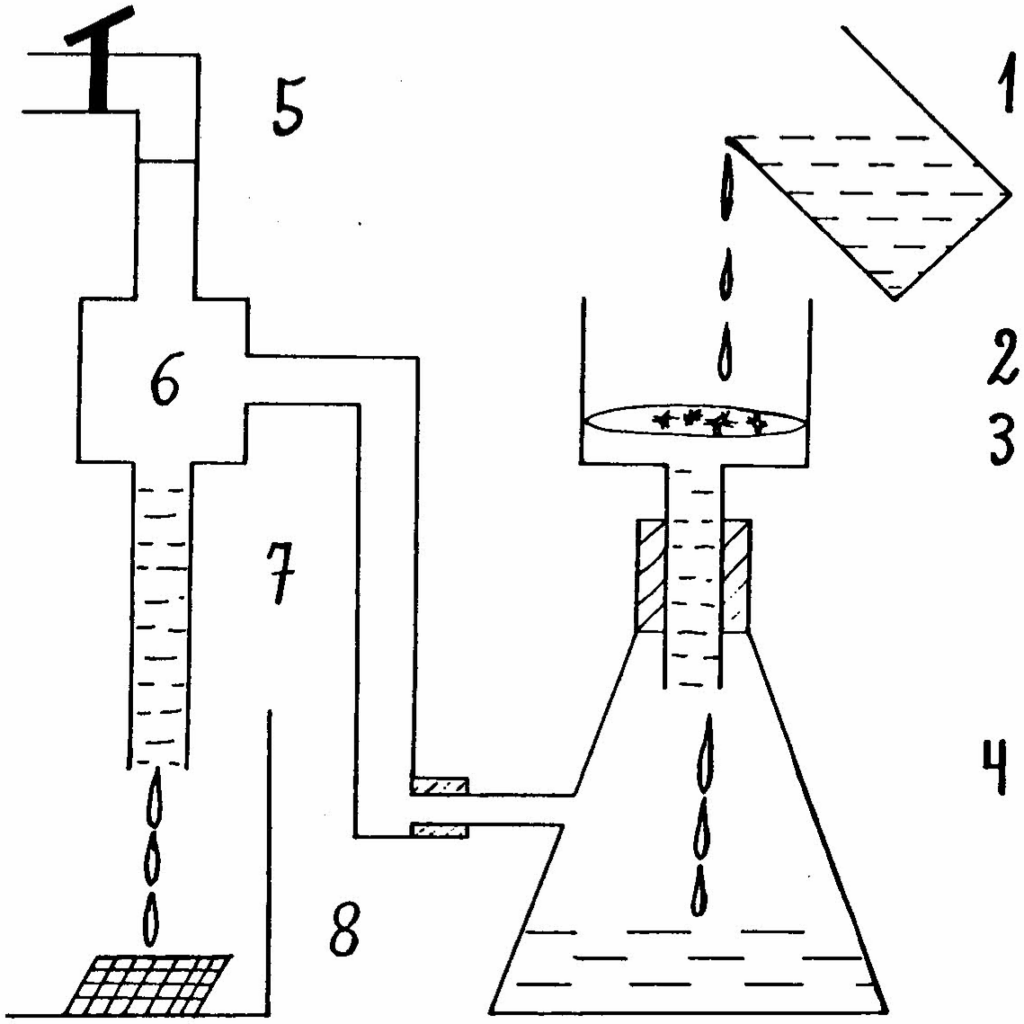
Fig.1. Filtration set for honey (schema): 1 – beaker, 2 – Büchner sifter funnel, 3 – filter paper, 4 – draw flask, 5 – tap (water inflow), 6 – water vacuum-pump, 7 – gum pipes connecting elements of set, 8 – sink (outflow of water)
Ryc.1. Zestaw do filtrowania miodu (schemat): 1 – zlewka, 2 – lejek sitowy Büchnera, 3 – sączek bibułowy, 4 – kolba ssawkowa, 5 – kran (dopływ wody z sieci), 6 – wodna pompa próżniowa, 7 – wężyki gumowe łączące elementy zestawu, 8 – zlew (odpływ wody z pompy)
strona 159Honey samples (50 g) free of mites were artificially contaminated and infested with 100 (each replication) determined objects – mite species (females, males), developmental stages – eggs, larvae, proto- and deutonymphs, hypopi (in the case of Carpoglyphus lactis /L./ only, tab.2), body parts (legs and their segments, gnathosomas) and other impurities (excrement clods of Dermatophagoides pteronyssinus /Trt/ only). Every variant (combination) of experiment was made in 1-10 replications (tab.1).
200 ml of distilled water was added to every such prepared sample and honey was dissoluted. Then honey solution was filtered by means of filtration set. After filtration of samples the number of acarological impurities settled on the surface of filter paper was microscopically determined and counted, and the efficiency of analysis was stated.
Measurements of body size (lenght, width) of mites were made on C.lactis – the commonest pest of honey. Dimensions of all developmental stages of the species (on the base of 100 specimens of each instar) were determined under microscope. Comparison of these data with technical parameters (mesh, aperture) of honey strainers taken from catalogues and professional literature was made (tab.4).
RESULTS
Acarological analyses of honey samples artificially infested with mites show that recommended standard method of detection of these pests is somewhat inacurate. Efficiency of detection of acarological contaminants in honey is dependent on mite species and their developmental stages (size, colour, sclerotization degree of their bodies). Bigger mite species, but especially their adult specimens are detectable in 76-100%. Tiny mites, e.g. youngest developmental instars of acarids – eggs, larvae, nymphs and their body parts (legs and their segments, gnathosomas, fragments of idiosoma, bristles) and faecal clods, are more difficult to detect (12-100%) (tab.1, 2).
Confrontation of dimensions of body of driedfruit mite (C.lactis) in various developmental stages with meshes of honey strainers recommended by various companies and authors shows that cleaning of honey off mites might be more effective in the case of adults and biggest deutonymphs than in the case of smaller objects in the first juvenile stages (eggs, larvae, protonymphs) and their body parts which are smaller than diameters of strainer meshes (tab.3, 4, fig.2-7). Other acarological contaminations of honey, e.g. fragments of mite bodies (pieces of idiosoma, mouth parts /gnathosoma/, legs and their segments), body hairs (setae) and other small objects are very difficult for separation from this product. Excrements of mites which enter into the composition of smallest fraction of contaminations and in addition belong to dissoluble in honey, are practically irremovable from it with the method of cleaning like this.
strona 160Table 1 Comparison of efficiency of acarological analyses (filtration method) of honey artificially infested with some mite species and polluted with various kinds of mite contaminations; n = 100-500 objects at every variant of experiment; number of replications – x1-10 Porównanie efektywności analiz akarologicznych (metoda filtracji) miodu sztucznie porażonego roztoczami kilku gatunków i innymi rodzajami zanieczyszczeń akarologicznych; n = 100-500 obiektów w każdym wariancie doświadczenia; liczba powtórzeń – x1-10
| Mite species Gatunek roztoczy |
Efficiency of detection (%) of mite contaminations in honey / Skuteczność wykrywania (%) zanieczyszczeń akarologicznych w miodzie: Adults Dorosłe |
Efficiency of detection (%) of mite contaminations in honey / Skuteczność wykrywania (%) zanieczyszczeń akarologicznych w miodzie: Hypopi Hypopusy |
Efficiency of detection (%) of mite contaminations in honey / Skuteczność wykrywania (%) zanieczyszczeń akarologicznych w miodzie: Eggs Jaja |
Efficiency of detection (%) of mite contaminations in honey / Skuteczność wykrywania (%) zanieczyszczeń akarologicznych w miodzie: Gnathosoma Gnatosoma |
Efficiency of detection (%) of mite contaminations in honey / Skuteczność wykrywania (%) zanieczyszczeń akarologicznych w miodzie: Legs Odnóża |
Efficiency of detection (%) of mite contaminations in honey / Skuteczność wykrywania (%) zanieczyszczeń akarologicznych w miodzie: Segments of legs Segmenty nóg |
Efficiency of detection (%) of mite contaminations in honey / Skuteczność wykrywania (%) zanieczyszczeń akarologicznych w miodzie: Excrement clods Grudki kału |
|---|---|---|---|---|---|---|---|
| Acarus siro L. | 88,0(87-89)^x5 | 68,0^x1 | |||||
| Carpoglyphus lactis (L.) | 89,1(76-100)^x10 | 87,5(87-88)^x2 | 30,6(12-46)^x5 | 72,0^x1 | |||
| Dermatophagoides pteronyssinus (Trt) | 17,2(7-25)^x4 | ||||||
| Glycyphagus domesticus (De Geer) | 90,5(83-96)^x5 | 88,0(86-90)^x2 | 12,0^x1 | 69,0^x1 | |||
| Lepidoglyphus destructor (Schr.) | 87,0(82-90)^x3 | ||||||
| Tyrophagus longior (Gerv.) | 87,2(85-92)^x5 | 46,0^x1 | 69,0^x1 | ||||
| Tyrophagus putrescentiae (Schr.) | 87,6(82-91)^x5 | 64,0^x1 | |||||
| Varroa jacobsoni Oud. | 99,6(98-100)^x5 | 76,0^x1 | 94,4(93-100)^x5 | 85,0(82-92)^x4 |
Table 2 Efficiency of detection of driedfruit mite – Carpoglyphus lactis (L.) in artificial infested honey according to developmental stage of this pest; 1-5 repetitions, n = 100-500 objects at every variant of experiments (100 acarids per 1 repetition) Skuteczność wykrywania roztoczka suszowego – Carpoglyphus lactis (L.) w sztucznie porażonym miodzie w zależności od stadium rozwojowego tego szkodnika; 1-5 powtórzeń, n = 100-500 obiektów w każdym wariancie doświadczeń (100 rozkruszków w 1 powtórzeniu)
| Development stage of acarid Stadium rozwojowe rozkruszka |
Efficiency of analyses – % detected mites / Skuteczność analiz – % wykrytych roztoczy: Average – Średnio | Efficiency of analyses – % detected mites / Skuteczność analiz – % wykrytych roztoczy: Range – Zakres |
|---|---|---|
| Egg – Jajo | 30,6 | 12 – 46 |
| Larva – Larwa | 57,6 | 50 – 71 |
| Protonymph – Protonimfa | 76,0 | 70 – 83 |
| Deutonymph – Deutonimfa | 89,0 | 85 – 95 |
| Adult male – Samiec dorosły | 87,9 | 81 – 95 |
| Adult female – Samica dorosła | 90,2 | 85 – 100 |
| Hypopal stage – Stadium hypopus | 87,5 | 87 – 88 |
Table 3 Body size of driedfruit mite, Carpoglyphus lactis (L.) – commonest and most important pest of honey, according to developmental instars; n = 100 specimens of every stage Wielkość ciała roztoczka suszowego, Carpoglyphus lactis (L.) – najpospolitszego i najważniejszego szkodnika miodu, zależnie od stadiów rozwojowych; n = 100 osobników każdego stadium
| Development stage Stadium rozwojowe |
Dimensions of body – average (range) in mm / Wymiary ciała – średnio (zakres) w mm: Length – Długość | Dimensions of body – average (range) in mm / Wymiary ciała – średnio (zakres) w mm: Width – Szerokość |
|---|---|---|
| Egg – Jajo | 0,123 (0,110-0,141) | 0,078 (0,073-0,086) |
| Larva – Larwa | 0,158 (0,110-0,202) | 0,080 (0,061-0,092) |
| Protonymph – Protonimfa | 0,237 (0,178-0,319) | 0,125 (0,098-0,153) |
| Deutonymph – Deutonimfa | 0,340 (0,276-0,399) | 0,173 (0,141-0,202) |
| Adult male – Samiec dorosły | 0,354 (0,301-0,442) | 0,183 (0,159-0,245) |
| Adult female – Samica dorosła | 0,437 (0,350-0,552) | 0,211 (0,178-0,264) |
| Hypopal stage – Stadium hypopus | 0,238 (0,202-0,270) | 0,161 (0,135-0,196) |
Table 4 Some technical parameters of strainers applied for cleaning of honey Niektóre parametry techniczne sit używanych do cedzenia miodu
| Kind of strainer set Rodzaj zestawu sit |
Technical data – mesh, aperture diameter, opening numbers per: 1cm, 1cm² (open area) Dane techniczne – mesz, średnica oczek, liczba otworów na: 1cm, 1cm² (pow. otwarta) |
Source of data Źródło danych |
Country Kraj |
|---|---|---|---|
| Single Pojedyncze |
18-35 openings/1cm; least aperture should not be greater than 0,175mm 18-35 otworów/1cm; najmniejszy otwór nie powinien być większy niż 0,175mm |
Bornus 1986, 1994 – personal communication – informacja ustna | Poland |
| Single Pojedyncze |
opening size – 0,8mm wielkość otworów – 0,8mm |
Apicoltura Catalogo Generale | Italy |
| Double Podwójne |
a) 64-80 openings/1cm² – 64-80 otworów/1cm² b) 320-350 openings/1cm² – 320-350 otworów/1cm² |
Katalog CSOP „Ogród” 1982 | Poland |
| Double Podwójne |
a) opening size – 2mm² – wielkość otworów – 2mm² b) opening size – 0,5mm² – wielkość otworów – 0,5mm² |
Thomas Catalogue | France |
| Double Podwójne |
a) 8 openings/1cm² – 8 otworów/1cm² b) 32 openings/1cm² – 32 otwory/1cm² |
Jachimowicz, Ruttner 1975, Pidek 1980 | Austria |
| Double Podwójne |
a) 30 openings/1cm² – 30 otworów/1cm² b) 80-100 openings/1cm² – 80-100 otworów/1cm² |
Marcinkowski 1994 | Poland |
| Double Podwójne |
a) mesh – 5/1cm – mesz – 5/1cm b) mesh – 13/1cm – mesz – 13/1cm |
Thorne LTD Catalogue | England |
Tabela 4 — dokończenie z s. 162 (w druku bez powtórzonej główki; wiersz nagłówkowy poniżej celowo pusty).
| Double Podwójne |
a) aperture – 0,5mm – otwory – 0,5mm b) aperture – 0,2mm – otwory – 0,2mm |
Thorne LTD Catalogue | England |
| Treble Potrójne |
apertures: 0,2-0,35-1,3mm otwory: 0,2-0,35-1,3mm |
Graze Catalogue | Germany |
| Treble Potrójne |
apertures: 0,5-0,8-1,4mm (wire diameters: 0,25-0,28-0,45mm, respectively) otwory: 0,5-0,8-1,4mm (odpowiednie średnice drutu: 0,25-0,28-0,45mm) |
Meier Catalogue, correspondence 1994 | Switzerland |
| Three types Trzy typy |
heavy, standard and ultra fine strainer cloth – monofilament mesh 0,24mm tkaniny do sit o większych, standardowych (średnich) i bardzo małych otworach – średnica 0,24mm |
Steele a. Brodie Catalogue, correspondence 1994 | England |
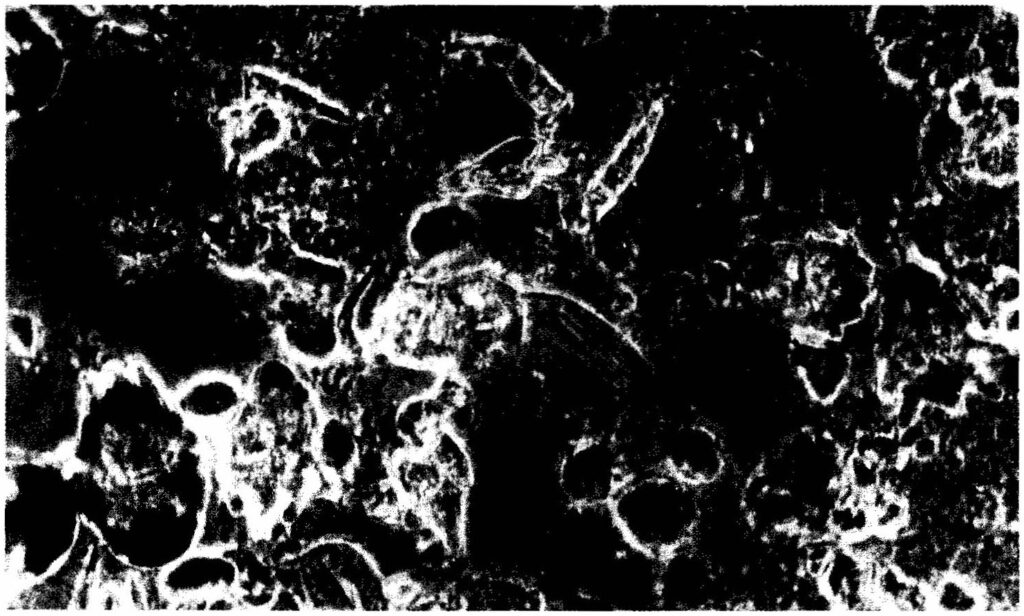
Fig.2. Sediment on the surface of filter paper containing acarological contaminations of honey (died mites, their body parts, excrements etc.)
Ryc.2. Osad na powierzchni sączka bibułowego zawierający akarologiczne zanieczyszczenia miodu (martwe roztocze, części ich ciał, odchody etc.)
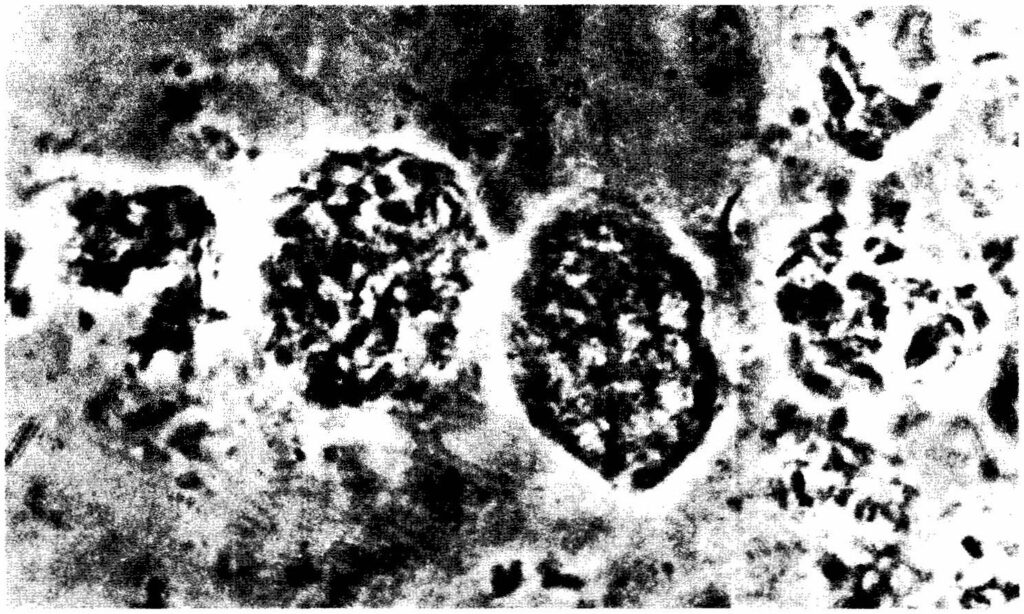
Fig.3. Excrement clods of driedfruit mite, Carpoglyphus lactis (L.) (natural size: 0,02-0,12 mm)
Ryc.3. Grudki kału roztoczka suszowego, Carpoglyphus lactis (L.) (wielkość naturalna: 0,02-0,12mm)
strona 165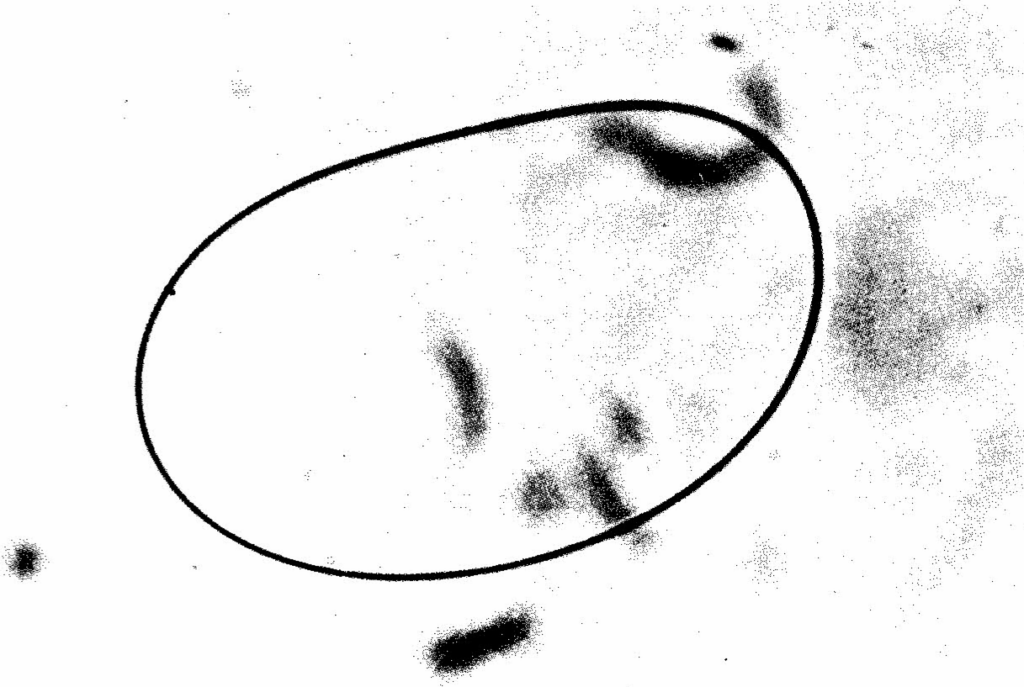
Fig.4. Egg of driedfruit mite, Carpoglyphus lactis (L.) (natural size: 0,12×0,08 mm)
Ryc.4. Jajo roztoczka suszowego, Carpoglyphus lactis (L.) (wielkość naturalna: 0,12×0,08 mm)
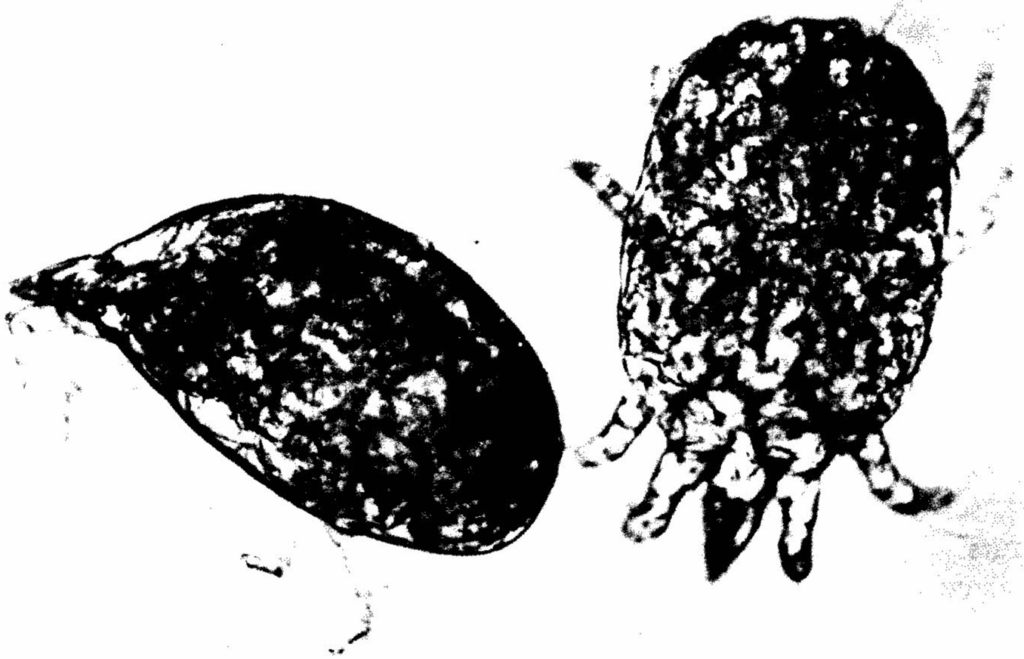
Fig.5. Deutonymphs of driedfruit mite, Carpoglyphus lactis (L.) before moulting (natural size: 0,34×0.17 mm)
Ryc.5. Deutonimfy roztoczka suszowego, Carpoglyphus lactis (L.) przed linieniem (wielkość naturalna: 0,34×0,17 mm)
strona 166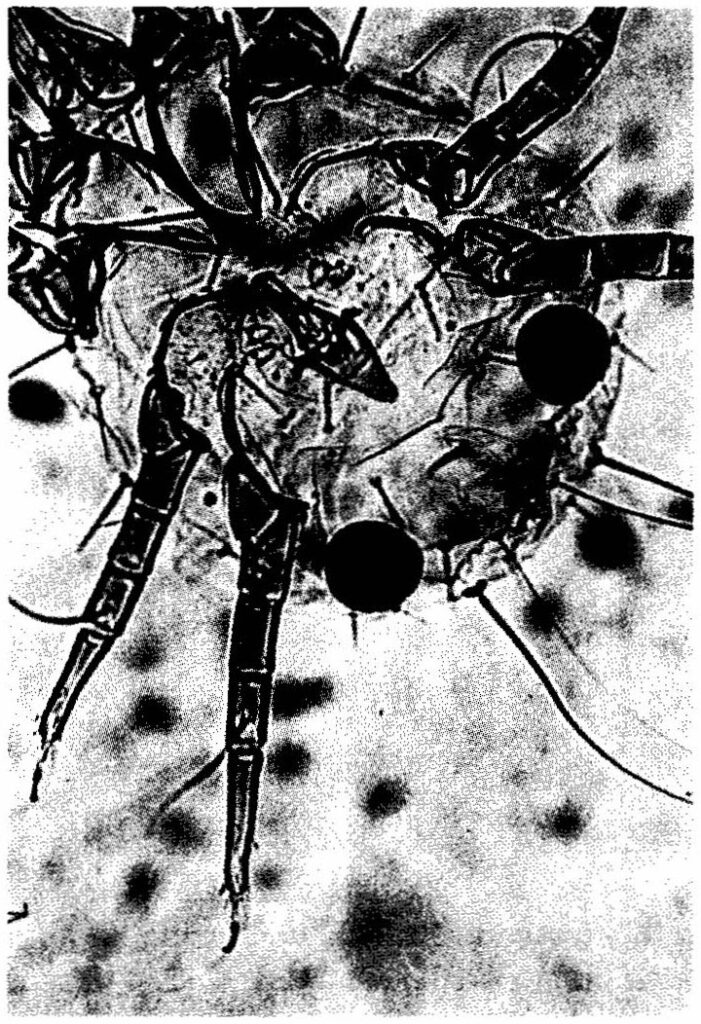
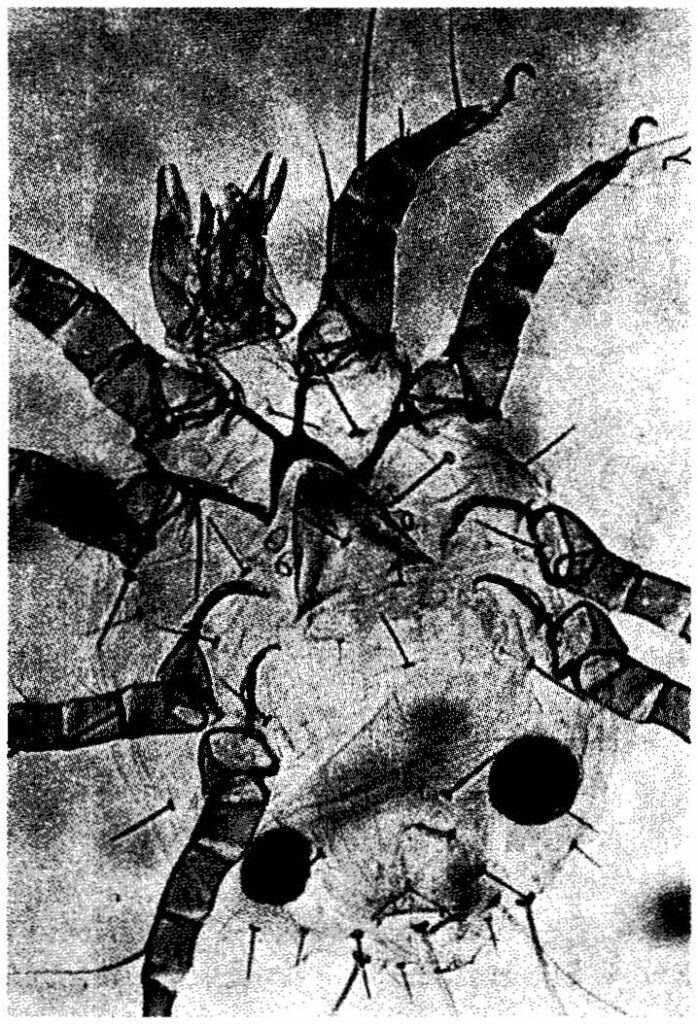
Fig.6. Adult male of driedfruit mite, Carpoglyphus lactis (L.) (natural size: 0,35×0,18 mm)
Ryc.6. Samiec dorosły roztoczka suszowego, Carpoglyphus lactis (L.) (wielkość naturalna: 0,35×0,18 mm)
Fig.7. Adult female of driedfruit mite, Carpoglyphus lactis (L.) (natural size: 0,43×0,21 mm)
Ryc.7. Samica dorosła roztoczka suszowego, Carpoglyphus lactis (L.) (wielkość naturalna: 0,43×0,21 mm)
CONCLUSIONS
- Efficiency of detection (filtration method) of mites in contaminated or infested honey depends on the kind of objects, i.e. mite species, their developmental stages, sexes (body size, colour, sclerotization).
- Larger objects (adult mites, intensive coloured specimens) and strongly sclerotized species are easily detectable, more than tiny, inconspicuous species, juvenile instars (eggs, larvae) or fragments of their bodies (gnathosoma, legs and their segments) and first of all mite excrements.
- Comparison of dimensions of mite bodies (various instars) with parameters of honey strainers (mesh, aperture) show that the efficiency of cleaning of contaminated honey (raw honey, secondary infested consumer product) seems to be not very satisfactory, especially in the case of small mite species, e.g.
acarid juvenile instars and other tiny objects – body hairs or excrement clods (these last ones are dissoluble in honey).
REFERENCES
Baker E.W., Delfinado M.D. (1978) – Notes on the driedfruit mite Carpoglyphus lactis (Acarina: Carpoglyphidae) infesting honeybee combs. J.Agr.Res., 17(1):52-54.
Banaszak J. (1980) – Badania nad fauną towarzyszącą w zasiedlonych ulach pszczelich. Fragm.Faun., 25(10):127-177.
Bornus L. (1986) – Miód pszczeli od producenta do konsumenta. PWRiL, Poznań, 55 ss.
Chmielewski W. (1971) – Badania nad składem gatunkowym roztoczy w zasiedlonych ulach pszczelich i w przechowalniach miodu. Pszczeln.Zesz.Nauk., 15(1-2):69-80.
Chmielewski W. (1989) – Roztoczek suszowy (Carpoglyphus lactis /L./) – szkodnik miodu. „Miód pszczeli – zastosowanie w lecznictwie” – Skrypt Konferencyjny, Częstochowa, 1989.12.06, :13-21.
Chmielewski W. (1990) – Roztocze – szkodniki produktów pszczelich. „Współczesne problemy pszczelarstwa w Polsce”. Materiały Ogólnopolskiej Naukowej Konferencji Pszczelarskiej, Olsztyn, 1990.12.07, :29-38.
Chmielewski W. (1991) – Roztocze (Acarida) pszczoły miodnej (Apis mellifera L.) w Polsce. Wiad.Parazyt., 37(1):91-94.
Chmielewski W. (1992a) – Roztoczek suszowy – groźny szkodnik miodu. Pszczelarz Polski, 1(10):12.
Chmielewski W. (1992b) – Varroa jacobsoni Oud. i inne roztocze (Acari) jako element organicznego zanieczyszczenia miodu pszczelego. Ann.Univ.M.Curie-Skłodowska, Lublin-Polonia, Sectio DD, 47(12):65-67.
Chmielewski W. (1995) – Akaroentomofauna miodu – gatunki, częstość i liczebność występowania. Pszczeln.Zesz.Nauk. (w przygotowaniu do druku).
Grobov O.F. (1975) – Kleščevaja fauna gnezda medonosnoj pčely i chranjaščegosja meda. Trudy Vsesojuz.Inst.Eksp.Veterinariji, 43:255-267.
Grobov O.F. (1991) – Klešči: parazity pčeł i vrediteli ich produkcii. Rosagropromizdat, 94 ss.
Haragsim O., Samšińák K., Vobrazkova E. (1987) – The mites inhabiting the bee-hives in ČSR. Z.Angew.Ent., 87(1):52-67.
Jachimowicz T., Ruttner H. (1975) – Ein leistungsfähiges Honigsieb. Apiacta, 10(4):170-172.
Marcinkowski J. (1994) – Podstawowe narzędzia w pracowni. Pszczelarz Polski, 1(5):14-15.
Pidek A. (1980) – Technologia prac pasiecznych w Austrii. Pszczelarstwo, 12:6-8.
Polska Norma – „Miód pszczeli” PN-88/A-77626.
strona 168ANALIZA AKAROLOGICZNA I SKUTECZNOŚĆ OCZYSZCZANIA MIODU Z ROZTOCZY
W. Chmielewski
Streszczenie
Badania przeprowadzono głównie na pospolitym szkodniku miodu – roztoczku suszowym (Carpoglyphus lactis /L./) w różnych stadiach rozwoju osobniczego, oraz częściowo na kilku innych gatunkach roztoczy często spotykanych w środowisku pasiecznym. Materiał doświadczalny uzyskiwano z monokultur laboratoryjnych. Roztocze określonego gatunku, płci i stadium rozwojowego, w liczbie 100 osobników wprowadzano sztucznie do 50g naważek czystego, wolnego od roztoczy miodu. Następnie wodne roztwory tak przygotowanych prób miodu o znanym porażeniu przesączano przez bibułę filtracyjną przy użyciu zestawu do filtrowania (lejek sitowy Büchnera + wodna pompa próżniowa). W wyniku badania mikroskopowego otrzymanego osadu ustalano liczbę znalezionych roztoczy. Skuteczność ich wykrywania zależy m.in. od gatunku, stadium rozwoju a nawet płci i jest największa w przypadku imagines (76-100%), mniejsza natomiast w przypadku osobników młodocianych – jaj, larw, nimf (12-100%). Jeszcze trudniejsze do wykrycia są inne drobniejsze obiekty (fragmenty ciała, ekskrementy roztoczy).
Z porównania wielkości ciała rozkruszków (pomiary wykonano na 100 osobnikach każdego stadium rozwojowego C.lactis) z parametrami technicznymi sit używanych do cedzenia surowca miodowego (średnica najmniejszych oczek ok. 0,17 mm; 80-100 do 320-350 oczek/1cm²) wynika, że zabieg może być skuteczny w przypadku imagines (wielkość ciała: 0,35-0,44 x 0,18-0,21 mm). Natomiast w przypadku roztoczy w młodocianych stadiach rozwojowych (0,12-0,34 x 0,07-0,17 mm) nie całkowicie spełnia swoje zadanie. Odchody roztoczy są praktycznie tą metodą z miodu nieusuwalne.
Słowa kluczowe: Acarina, roztocze, szkodniki, produkty pszczele, miód.
Errata — błędy druku znalezione podczas digitalizacji
- s. 157, streszczenie: „Than water” → Then water
- s. 157: „et all.” → et al.
- s. 158: „controled” → controlled
- s. 159: „lenght” → length
- s. 159: „inacurate” → inaccurate
- s. 167, piśmiennictwo: „pčeł” → pčel
- s. 167, piśmiennictwo: „Samšińák” → Samšiňák