

MATING BEHAVIOUR OF APIS MELLIFERA L. QUEENS ON AN ISLAND FREE OF DRONES
tekst: Job P. van Praagh, Peter Neumann, Gudrun Koeniger, Robin F. A. Moritz, Jost H. Dustmann
Pszczelnicze Zeszyty Naukowe, Rok XL, 1996 — Job P. van Praagh, Peter Neumann, Gudrun Koeniger, Robin F.A. Moritz, Jost H. Dustmann
strona 25PSZCZELNICZE ZESZYTY NAUKOWE Rok XL, Nr 2 1996
Job P. van Praagh, Peter Neumann *), Gudrun Koeniger **), Robin F.A. Moritz *), Jost H. Dustmann
Niedersächsisches Landesinstitut für Bienenkunde Wehlstraße 4a D 29221 Celle, GERMANY *) Institut für Ökologie und Biologie TU Berlin Franklinstr. 28/29D 10587 Berlin, GERMANY **) Institut für Bienenkunde (Polytechnische Gesellschaft) Karl-von-Frisch-Weg 2 D 61440 Oberursel, GERMANY
Summary
The quality of the Isle of Baltrum as an isolated mating yard, in between the island mating yards of Norderney and Langeoog, was to be tested. Baltrum is free of honeybee colonies and of drones. In five series, a total of 256 mini-nucs with young unmated quees were taken to the West-Frisian islands of Norderney, Baltrum and Langeoog. A larger number of queens was lost on Baltrum. The differences in the numbers of queens lost (Baltrum versus Norderney-Langeoog) proved to be significant in those cases where the mating conditions on the regular matings yards turned out to be optimal (eg. >60% mated queens).
The queens released on the drone-free island showed a delayed onset of egg-laying (35 days after emergence compared to 18,6 days for the control queens). The spermcounts of the queens from Baltrum revealed a small quantity of sperm in the spermatheca. This does not always correspond with the number of males found by means of DNA-fingerprinting of the workers (daughters of those queens). Mating is possible under extremely difficult conditions. Our results suggest that controled mating under the given conditions cannot be gvaranteed. To clarify the quality of Baltrum as an isolated mating yard, further experiments – eg. with drones on Baltrum – have to be done. Keywords: Apis mellifera, controlled mating, island mating yards, mating flights.
INTRODUCTION
Usually recessive body-colour mutants of the honeybee (Apis mellifera L.) are used to estimate the number of uncontrolled matings taking place at mating yards on the mainland (Maul 1972, Englert 1972). The Westfrisian Isle of Baltrum is a part of the protective surroundings of the island mating yards of Norderney and Langeoog. Both islands are supposed to be safe independent mating yards. Using the techniques of DNA-fingerprinting, common wild-type queens and drones may be used to
strona 26assess the degree of isolation of a mating yard. It was to be examined, if in case of the use of Baltrum as a mating yard, this would interfere with the security of Norderney and Langeoog.
As a first step, the isolation of Baltrum as an island mating yard was checked. eg. Are young virgin queens on the drone-free Isle of Baltrum mated, and if so, where do the drones come from?
MATERIAL AND METHODS
During both years (1995 and 1996) the islands of Norderney and Langeoog were used as regular island mating yards (drones being present). The neighbouring Isle of Baltrum was kept free of drones. Distances from the position of the experimental queens at Baltrum towards the known positions of male colonies on the islands of Norderney and Langeoog and towards the mainland are given in table 1.
Table 1
The distances and directions from the position of the experimental queens on Baltrum towards the mating yards / mainland are given. The distances to be flown across open water in the given directions at low and high tide are also given.
| from Baltrum towards | Norderney | Langeoog | Mainland |
|---|---|---|---|
| distance in km | 13,2 | 7,8 | 5,4 |
| direction | 95° West | 80° East | 170° West |
| km across flooded area, low tide | 0,75 | 1,4 | 0,2 |
| km across flooded area, high tide | 1,15 | 2,5 | 5 |
In 1995, 3 series with 24 experimental mating nuclei each were placed on the Isle of Baltrum; a total of 72 control nuclei were used on Norderney and Langeoog. Sister-queens were used for each series. In 1996, two series with a total of 108 nuclei were conducted. The details can be found in table 2. Queens were about 7 days old at their introduction on the isles.
At the return of each series in Celle, all nuclei were checked for the presence of queen and brood. Queens without brood of the series I/95 and II/95 were given another opportunity of flying out at Celle this time. We expected to give those 4 week old queens a chance to mate. The queens in nuclei of the series III/95, I/96 and II/96 were wingclipped at their return and a queen excluder was positioned in front of the mating nuclei. Any mating flight on the mainland was prohibited. The time of egg-laying and kind of brood were registered for each available queen.
strona 27Table 2
The main data body.
| Series | Time at mating yard | Norderen: mated | Norderen: in % | Baltrum: returned | Baltrum: in % | Baltrum: mated | Baltrum: in % | Langeoog: mated | Langeoog: in % |
|---|---|---|---|---|---|---|---|---|---|
| I/95 | 12.06.95 unti 03.07.95 | 6 | 50 | 9 | 37,5 | 0 | 0 | 7 | 58,3 |
| II/95 | 03.07.95 until 24.07.95 | 11 | 91,7 | 11 | 45,8 | 2 | 8,3 | 11 | 91,7 |
| III/95 | 24.07.95 until 16.08.95 | 6 | 50 | 13 | 54,2 | 11 | 45,8 | ||
| I/96 | 06.07.96 until 22.07.96 | 1 | 16,7 | 8 | 33,3 | 6 | 25 | 6 | 25 |
| II/96 | 22.07.96 until 12.08.96 | 13 | 54,2 | 12 | 40 | 2 | 6,7 | 13 | 72,2 |
The number of control-queens from Norderney and Langeoog mated during the three weeks they spent on the islands was identical with the number of queens we found. All the controlqueens found were mated. The number of experimental queens found after three weeks at Baltrum was not identical with the number of queens mated. Some produced males only; they were considered as „not mated”
Worker bees (daughters of all the mated queens) of series III/95 were used for DNA-fingerprinting (Neumann et al. 1996). The number of sperm in the spermatheca of the Baltrum-queens of that series was estimated. At three different days, the mating flight behaviour of queens at Baltrum was observed.
RESULTS
QUEEN LOSSES.
Compared to the queen losses from the controls (Norderney and Langeoog together), more experimental Baltrum queens were lost (table 2). Those losses were significant in those cases where the situation for mating on the control islands turned out to be optimal eg.>60% mated queens.
strona 28MATED QUEENS.
In series III/95 the percentage of mated experimental queens is not significantly lower than the percentage of the control group. For the series I/96 (p<=0,05) and II/96 (p<=0,01) on the other hand a significantly (chi-square-test) lower percentage of mated queens of the total amount of the experimental queens (from Baltrum) could be observed (table 2), compared to the control group of Norderney and Langeoog. Nearly all queens from the series II/95 and III/95 that were mated on mating flights that started from Baltrum, a nearly normal amount of sperms was estimated (>= 2*10^6).
TIME OF EGG-LAYING
Successfully mated queens from Baltrum started their egg-laying later (fig. 1 and fig. 2), compared to the control queens on Norderney and Langeoog where there were drones present on the islands.
FLIGHT-TIMES
The observed flight times of queens flying out from Baltrum returning with a mating sign was extremely long. From table 3 it becomes obvious, that it took them at least 31 minutes to fly away, mate and return to the nucleus.
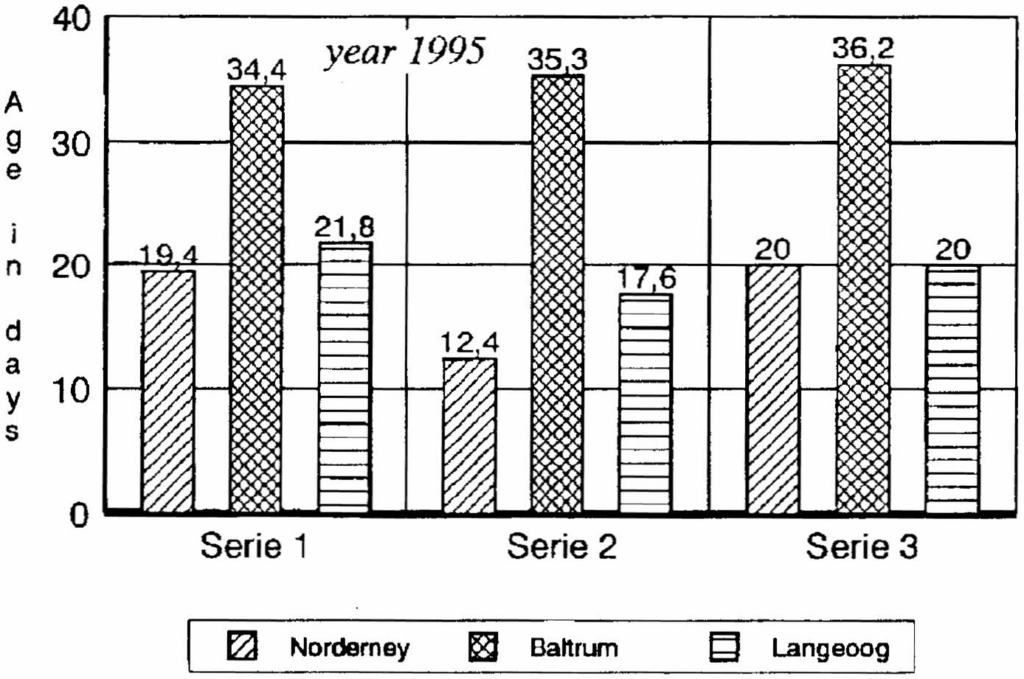
Fig.1. Age of the queens at the onset of egg-laying activity. The three series of the year 1995 are depicted.
strona 29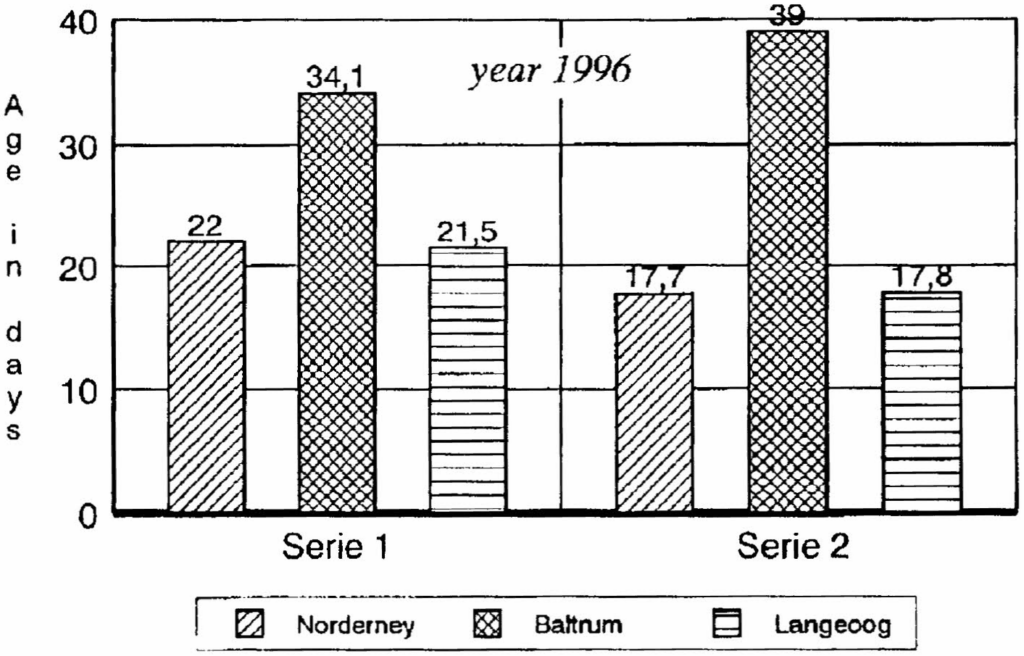
Fig. 2. Age of the queens at the onset of egg-laying activity. The two series of the year 1996 are depicted.
DISCUSSION
The larger distances towards the position of male spending colonies seem to cause queen losses. Queens that fly out on an island,used as a mating yard, mate relatively easily with males. If there are no male-producing colonies positioned on the island, more young unmated queens are lost. Szabo reports higher rates of queen-losses on the mainland for those queens that are positioned far away from the male-spending colonies (Szabo 1986). He discusses four possible reasons for the lost. (1) queens exhausted their energy during the long search for drone congregation areas; (2) they were captured by predators or overtaken by sudden cold weather; (3) they were attacked and killed by their own nuclei; and (4) tired queens returned into strange nuclei and were killed by the workers. Suggestion 3 according to Szabo, cannot be ruled out in our case. Following the transport back to the mainland (Celle), we found 3 queens from Baltrum dead inside the mating nucleus in series I/96. Of those three queens, only queen C3 (table3) had a filled spermatheca. We left the mating nuce that contained queen C5 (table 3) behind (22.07.96), the queen still on flight as we left. After the transport back to the mainland on August 12 we found the queen egglaying since July 24..
strona 30Table 3
The length of the flights we could observe on Baltrum. The time of their take-off; the time of return, and the age of the queen on the day of observation is given. The oberved presence of a mating-sign at return is given.
| Queen | Date and time out | in flight time | age (days) | return with mating sign? |
|---|---|---|---|---|
| A1 | 24.07.95 13.46h | 4 minutes | 27 | no |
| 24.07.95 13.57h | 22 minutes | 27 | no | |
| 24.07.95 14.25h | 11 minutes | 27 | no | |
| 24.07.95 14.42h | 7 minutes | 27 | no | |
| B2 | 24.07.95 13.50h | 3 minutes | 27 | no |
| 24.07.95 14.04h | 6 minutes | 27 | no | |
| B3 | 24.07.95 13.46h | 10 minutes | 27 | no |
| B4 | 24.07.95 13.46h | 10 minutes | 27 | no |
| B5 | 24.07.95 14.55h | 6 minutes | 27 | no |
| C5 | 22.07.95 14.53h | 50 minutes | 25 | yes |
| 22.07.95 15.47h | 50 minutes | 25 | lost | |
| 22.07.95 16.42h | > 18 minutes | 25 | queen returned -?- | |
| C3 | 22.07.95 15.47h | 31 minutes | 25 | yes |
| D1 | 12.08.96 14.02h | 1 minute | 28 | no |
Eg. queen C5 returned after the first flight with a mating sign; left again after staying 4 minutes in the mini-nuc; it returned without a visible mating sign. She must have returned from her third flight on that day
The in- flight times observed on July 24 in 1995 (queens returning without a mating sign) are as long as the times observed by Koeniger (1976) for one single mating flight, and by Koeniger et al. (1989) for queens returning with a mating sign. At Baltrum, queens must apparently fly extremely long times to meet with drones, and return with a mating sign. Our data (31 minutes and twice 50 minutes) lay far beyond the figures published by Koeniger et al.
Using a supposed flightspeed of 21,5 km/h (Szabo 1986) queen C5 found drones within 8 km from her position at Baltrum, allowing 5- minute stay to meet the drones. At the time of her flights the tide was high. The extremely different weather conditions of 1995 and 1996 can very well be the cause of the different amounts of queenlosses observed in 1995 or
strona 311996 (Szabo’ s cause 2). A delayed onset of egglaying was observed for those mated queens, which were positioned at Baltrum (their mean age being 35 days for the experimental queens and 18,6 days for the control queens). This delay also indicates longer distances towards the drone colonies (Szabo 1986).
The DNA-fingerprinting of single worker bees (series III/95.) indicates a higher mating frequency for the control-queens from Norderney (6,5 males) and Langeoog (10,3 males) compared to the experimental queens from Baltrum (3,1 males) The queens flying out from Baltrum significantly mated (p<0,0001) with fewer males. (Neumann et al.). It may be assumed, that the number of sperm found in the spermatheca of a queen must not necessarily correspond with the number of males found by DNA-fingerprinting of daughters of that queen.
The results make clear that controlled mating (eg. no mating) under the condition that no males are available on the island is not fullfilled. The queens start vagabonding and get mated under more difficult conditions. So under the given condition, Baltrum must be considered as an unreliable mating yard in the absence of drone colonies. Interaction between queens on Baltrum and males „from the vicinity” cannot be excluded under the circumstances given.
The fact that there were no males on the Isle of Baltrum offers very difficult mating conditions, as was expected. But, nevertheless, queens are able to mate successfully. The question remains if the interaction with males from a far-away position remains under „normal mating yard conditions”. The DNA-fingerprinting (Neumann et al.) reveals an interaction mainly with drones from the mainland.
REFERENCES
Englert E. (1972) – Belegstellen-Prüfung im Cordovan-Test. In: Ruttner F., Ruttner H., Harnaj V.,Ed.- Paarungskontrolle und Selektion bei der Honigbiene. Apimondia-Verlag. 48.
Koeniger G. (1976) – Einfluß der Kopulation auf den Beginn der eiablage bei der Bienenkönigin (Apis mellifica L.). Apidologie 7(4);343-355.
Koeniger G., Koeniger N., Pechacker H., Ruttner F., Berg S. (1989) – Assortive mating in a mixed population of european honeybees, Apis mellifera ligustica and Apis mellifera carnica. Insectes Sociaux 36(2);129-138.
Maul V. (1972) – Belegstellen-Prüfung im Cordovan-Test. In: Ruttner F., Ruttner H., Harnaj V.,Ed.- Paarungskontrolle und Selektion bei der Honigbiene. Apimondia-Verlag. 46-48.
Neumann P., van Praagh, J.P., Moritz, R.F.A., Dustmann, J.H. (1996) – Überprüfung der potentiellen Belegstelle Baltrum mit Single Locus DNA-Fingerprinting. In Symposium bericht Olsztyn
Szabo. T. I. (1986) – Mating distance of the honeybee in north-western Alberta Canada. Journal of apicultral Research. 25(4);227-233
strona 32UNASIENIANIE MATEK PSZCZELICH (APIS MELLIFERA L) NA WYSPIE WOLNEJ OD TRUTNI
J. P. van Praagh, P. Neumann G. Koeniger, R.F.A. Moritz, J. H. Dustmann
Streszczenie
W 1995 i 1996 sprawdzono przydatność wyspy Baltrum jako naturalnego trutowiska. Na wyspach Norderney, Baltrum i Langeoog wystawiono łącznie 5 serii ulików weselnych z matkami-siostrami (Tabela 2). Po powrocie z lotów matki nieunasienione pozostawiano do dalszych lotów (I/95,II/95), lub przycinano im skrzydełka i kratowano wyloty (III/95, I/96, II/96). Określano termin rozpoczęcia czerwienia i pobrano próby młodych robotnic w celu analizy DNA.
Przy okazji obserwowano na Baltrum zachowania wylatujących matek. U unasienionych matek z tej grupy określono liczbę plemników. W 1995 roku nie stwierdzono różnic statystycznych w wynikach unasieniania pomiędzy grupami: Baltrum a kontrolną (Norderney i Langeoog). Istotne różnice wystąpiły jednak w 1996 (tabela 2).
Stwierdziliśmy wyraźnie późniejsze rozpoczęcie czerwienia we wszystkich 5 seriach na wyspie Baltrum. Matki latały również przy odpływie i powracały ze znamieniem weselnym (Tabela 3). Liczba plemników i stwierdzonych trutni nie zawsze się zgadzały. Matki były unasieniane przez trutnie zalatujące z sąsiednich wysp. Z tego wynika: 1.zwiększenie się strat matek 2.opóźnienie czerwienia 3.niewielu partnerów każdej matki, każda matka kojarzy się z kilkoma różnymi trutniami. Słowa kluczowe: Apis mellifera, unasienianie, trutowisko na wyspie, loty godowe
Errata — błędy druku znalezione podczas digitalizacji
- s. 25: „quees” → queens
- s. 25: „controled” → controlled
- s. 25: „gvaranteed” → guaranteed
- s. 27, tab. 2: „Norderen” → Norderney
- s. 27, tab. 2: „unti” → until
- s. 29: „nuce” → nuc
- s. 30, tab. 3: „oberved” → observed
- s. 31: „fullfilled” → fulfilled
- s. 31, piśmiennictwo: „Assortive” → Assortative
- s. 31, piśmiennictwo: „apicultral” → apicultural