

CORRELATION BETWEEN BROOD NEST AND AMBIENT TEMPERATURES IN THE HONEY BEE COLONY (Apis mellifera)
tekst: Jovan M. Kulinčević, Suzane B. Grant, Walter C. Rothenbuhler
Pszczelnicze Zeszyty Naukowe, Rok XXXI, 1987 — Jovan M. Kulinčević, Suzane B. Grant, Walter C. Rothenbuhler
strona 257PSZCZELNICZE ZESZYTY NAUKOWE ROK XXXI 1987
Jovan M. Kulinčević, Suzane B. Grant and Walter C. Rothenbuhler
Department of Entomology The Ohio State University Columbus, Ohio 43210
Summary
The effect of ambient temperatures (5—33°C) on brood nest temperatures (32.1—38.5°C) in honeybee colonies (Apis mellifera) during active brood rearing season has been studied. There were significant correlations between brood nest and ambient temperatures at lower than 15.5°C and higher than 22.0°C ambient temperatures. However, in the range of 15.5—22.0°C of ambient temperature, honeybees kept the brood nest temperatures constant.
INTRODUCTION
The regulation of nest and brood rearing temperature is a general capability of the most advanced social insect. The best understood of this regulation mechanism is termoregulation in a honeybee colony.
- Present address: Pčelarski kombinat „Beograd” Jovana Rajića 5, 11000 Beograd Yugoslavia
In the past there have been numerous reports on cluster and brood rearing temperatures. Most reports originated in the 1920’s and 1930’s, or even earlier. Gates (1914) reported that the temperature at the center of the brood nest remained remarkably constant, between 34—35°C, and there was no appreciable correlation between the brood nest and ambient temperature in summer. Hess (1926) found that the daily range of fluctation was not more than 0.2—0.4°C. He reported that the brood comb temperature averaged 34.8±0.3°C. In his view the vital limits for brood were between 32 and 36°C. Owens (1971) stated that the temperature within a cluster varies, but under normal condition is not closely correlated with the ambient temperature. His studies were mostly devoted to winter cluster investigations of honeybee colonies. Free (1977) pointed out that at an outside temperature of about 50°C, colonies can maintain their brood area at temperatures of about 35°C indefinitely. Lindauer (1961) taught the same. Most recent review of this subject is given by Heinrich (1981). In that review the range of the brood nest temperature from 32—36°C is supported.
Working on a related problem (Grant, 1981), it was suspected a wider range in brood rearing temperatures than previously reported. Therefore, we undertook these investigations.
MATERIALS AND METHODS
Nine colonies of honeybees from two different stocks were utilized in this study at the Ohio State University Bee Laboratory. Stock 1 (4 colonies) came from Canada and Stock 2 (5 colonies) came from Texas.
These colonies were maintained in two-story Langstroth hives until May 19, when supers were added as required. Entrance reducers were removed in early May. All of the colonies faced south and were shaded during part of the day.
Twenty 24-gauge copper-constantan thermocouples were installed in each colony, ten per story. The thermocouples were arranged to encompass the brood nest (Fig. 1). A thermocouple was placed between each frame, so that it extended to half the depth on the comb, 11.4 cm from the top bar, and tacked in place. One thermocouple was placed between the wall and outside comb.
The twenty thermocouples were connected to a switch, which was plugged into a Bailey Bat-4 thermometer. The measurements were taken at random times during the day. Readings were accurate to ±0.1°C. The results presented are based on 5,000 measurements that were taken at least once a week from March until July.
strona 259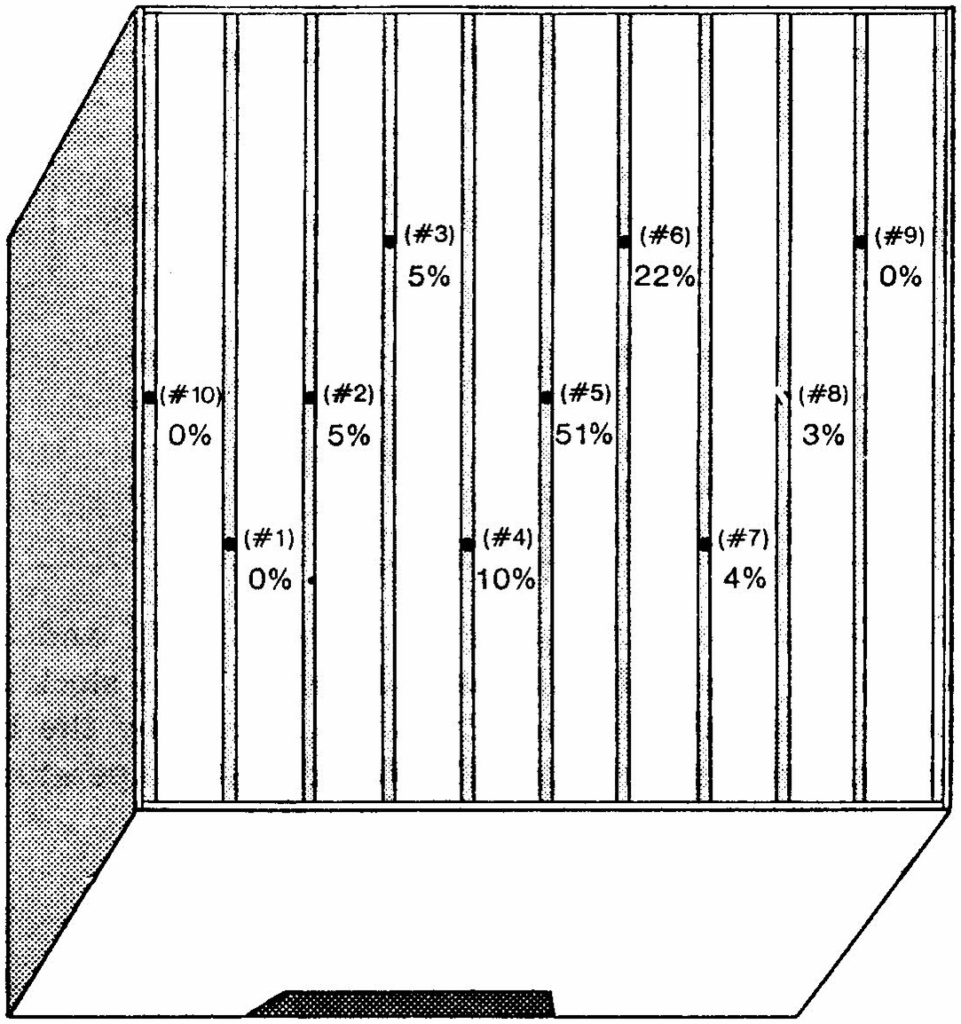
RESULTS, DISCUSSION AND CONCLUSIONS
Figure 1 shows the percent of time that the maximum brood nest reading occurred at that thermocouple. The maximum temperature was found in the center of one of the two brood chambers during 51% of the observations. The next hottest place was at thermocouple 6, which was located further from the entrance. In very few observations, the maximum was located next to the wall of the hive. These measurements were not taken in account, because they might have resulted from direct sun heat.
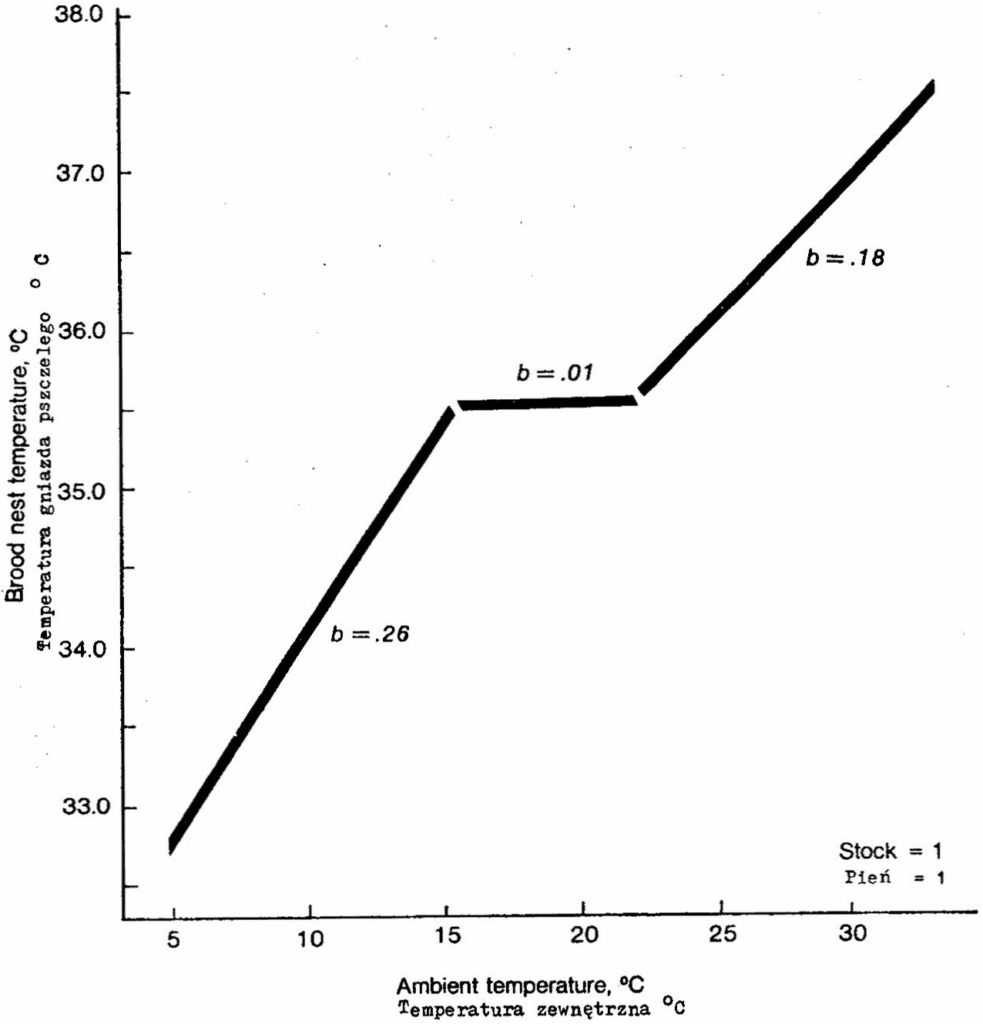
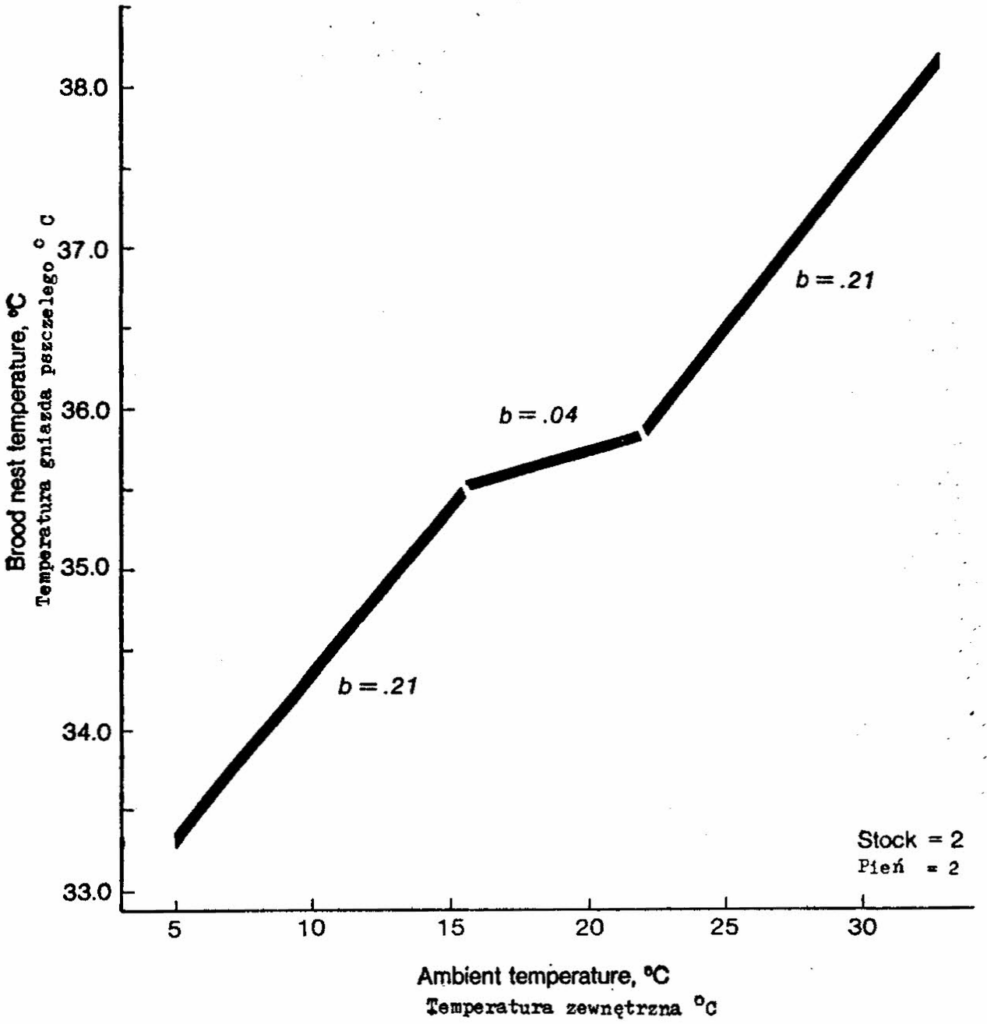
Measurements of brood nest temperatures in the nine colonies, from the two different stocks of honeybees, showed that the temperature during the active brood rearing season can fluctuate more widely than some other investigators have reported. Maximum brood nest temperatures ranged from 32.1°C to 38.5°C during ambient temperatures of 5° to 33°C.
The positive correlation was found between the ambient and brood nest temperatures. However, the regression line was not a straight line (Figures 2 and 3). The correlation holds true for ambient temperatures at
strona 260Table 1 Differences on correlation between brood nest and ambient temperatures in two stocks of honeybees
| Stock | N | Ambient Temperature in C° | Correlation Coefficient | Slope | Level of Significance |
|---|---|---|---|---|---|
| 1 | 4 | < 15.5 | 0.93 | 0,26 | 0.0001 |
| ≤ 15.5–22.0 | −0,04 | 0.01 | NS | ||
| > 22.0 | 0,73 | 0.18 | 0.0001 | ||
| 2 | 5 | < 15.5 | 0.86 | 0.21 | 0.0001 |
| ≤ 15.5–22.0 | −0.02 | 0.04 | NS | ||
| > 22.0 | 0.85 | 0.21 | 0.0001 |
<15.5°C and >22.0°C. At temperature between 15.5° and 22.0°C, the correlation was not present (r=.01 stock 1 and r=−0.4 stock 2). A fairly constant temperature, about 35.5°C, was maintained by the bees within this range of ambient temperatures. The brood nest temperature of 35°—
36°C is generally supported as stated by Heinrich (1981) as a constant through the brood nest rearino season. Heinrich 1981) found that the core temperature of natural swarms was also maintained between 35 and 36°C.
What is the reason for the lack of correlation between the ambient and maximum brood temperatures in other reports? There are some indications that most of the earlier investigators took measurements of brood nest temperatures at the time when the ambient temperaure was between 15—25°C (Mathis, 1961) and 18—25°C (Gates, 1914).
REFERENCES
Free J. (1977) The social organisation of honey bees. Edward Arnold. London.
Gates, B. N. (1914). The temperature of the bee colony. Bull. USDA. No. 96, 1—29.
Grant, S. (1979). Differences in thermoregulation among colonies of the honey bee (Apis mellifera). M. S. Thesis, The Ohio State University, Columbus, Ohio.
strona 262Heinrich, B. (1981). Energetics of honeybee swarm thermoregulation. Science, 212 : 565—566.
Hess, W. R. (1926). Die Temperaturregulierung im Bienenvolk. Z. vergl. Physiol. 4 : 465—87.
Lindauer, M. (1961). Communication among social bees. Cambridge, Mass. Harvard University Press.
Mathis, M. (1952). Mise en evidence dans une colonie d’abeilles d’un centre thermique autoregulateur resistance de ce centre aux chocs thermiques. Ann. Des. Sc., Nat. Zool. 11 : 433—437.
Owens, D. C. (1971). The thermology of wintering honey bee colonies. Bull. USDA No. 1429 : 1—32.
Ribands, R. (1953). The behaviour and social life of honey bees. London Bee Res. Assn. Ltd. Republished 1964by Dover Publ. Inc., New York.
Seeley, T., Heinrich, B. (1981). Regulations of temperature in the nests of social insects, pp. 206—207 (In: B. Heinrich Insect Thermoregulation). John Wiley and Sons, New York.
Southwick, E., Mugaas, J. (1971). A hypothetical homeotherm: the honey bee hive. Comp. Biochem. Physiol. 40 : 935—944.
Wohlgemuth, R. (1957). Die Temperaturregulation des Bienenvolkes unter regeltheoretischen Gesichtspunkten. Zeitschr. Vergl. Physiol. 40 : 119—161.
ZALEŻNOŚĆ MIĘDZY TEMPERATURĄ CZERWIU A OTACZAJĄCĄ TEMPERATURĄ GNIAZDA RODZINY PSZCZELEJ (APIS MELLIFERA)
Jovan M. Kulinčević
Streszczenie
Badania dotyczyły wpływu temperatury gniazda pszczelego od 5 do 33°C na temperaturę czerwiu (32,1—38,5°C) u Apis mellifera w okresie aktywnego sezonu. Znaleziono wysoce istotną korelację między tymi dwoma zakresami temperatury jednak z warunkiem, że temp. gniazda nie spada poniżej 15,5°C i nie podnosi się ponad 22,0°C. W zakresie między 15,5—22,0°C w gnieździe, pszczoły utrzymywały stałą temperaturę czerwiu.
Errata — błędy druku znalezione podczas digitalizacji
- s. 257: „termoregulation” → thermoregulation
- s. 258: „fluctation” → fluctuation
- s. 259, podpis ryc. 1: „highes” → highest
- s. 261, podpis ryc. 2, 3: „ambinet” → ambient
- s. 261: „rearino” → rearing
- s. 261: „temperaure” → temperature
- s. 262, piśmiennictwo: „Ribands” → Ribbands
- s. 262, piśmiennictwo: „1964by” → 1964 by