

ORGANIZATION OF HONEY SUPPLIES FOR INHABITANTS OF CRACOW
tekst: Janina Marzec
Pszczelnicze Zeszyty Naukowe, Rok XL, 1996 — Janina Marzec
strona 199PSZCZELNICZE ZESZYTY NAUKOWE Rok XL, Nr 2 1996
Janina Marzec
Department of Vegetable Crops with Horticulture Economics, Agricultural University of Cracow, Al. 29 Listopada 54, 31-425 Cracow, POLAND
Summary
The honey market in Cracow was restructured in the nineties. The quota of socialized units in honey turnover declined visibly and new entrepreneurs, i.e. trading companies and capital partneships became dominant suppliers of honey to shops. Over the investigated period, the share of five main honey suppliers to the analyzed shops ranged from 36 to 16%. The monthly sales level at retail outlets varied from 10 to 100kg, whereas in wholesale companies it was 2000 kg. Shops applied 10-25% profit margins, the wholesale companies from 5 to 10%. Both wholesale and retail prices of honey were highly diversified over the whole analyzed period. The highest were maintained for hoeny dews, the lowest for rape honeys. Consumesr preferences as to the sort of honey were matched by the trade offer.
Keywords: honey,
INTRODUCTION
Channels of honey distribution in the world are diversified depending on a market. In Europe, honey trade is still dominated by agents and importers, but other forms of distribution become apparent too. For example, in Germany and Great Britain, beekeepers sell honey both direct to smaller retailers or to consumers. In Belgium, the important local wholesaler distributes honey through a network or in a franchised system. In France two thirds of honey reaches consumers through roadside sales, local marketplaces, speciality shops or smaller groceries. Most of Dutch companies import honey directly, but some amounts are imported also through German or British agents and traders. In USA and Japan most marketed honey comes from imports dominated by big trading companies (Honey: A study of major markets, 1986).
In constantly changing economy in Poland, a proper sales strategy is a key factor to achieve success on the market. The new situation on the market necessitates alterations in the organization and functioning of distribution. In order to achieve the aims set for the sale, a ready product must match the consumers’ needs, i.e. it must be offered in a proper form, at the right time and place (G a r b a r s k i et. al. 1992).
strona 200In the nineties, some basic structural changes were observed on the bee products market (C i c h o ń and W i l d e 1986; M a r z e c 1996; P i d e k 1994). These changes concern both the units which participate in the bulk transfer from beekeeper to consumer, the routes of transfer and assortment range of honeys offered to consumers.
The aim of conducted marketing studies was to collect data on potential honey sale capacity and its conditions both in wholesale and retail in Cracow.
METHODS
Information concerning modifications in the arrangement of honey supplies for the inhabitants of Cracow was gathered through marketing studies carried out in 1994 and 1995. The information was elicited by means of direct observations, surveys and interviews with salespersons at retail outlets, and with wholesalers. The investigations were based on a randomly chosen sample of general population. Data were collected by means of direct measurment. The studies included 192 groceries localized in the following quarters of Cracow: Krowodrza (23%), Śródmieście (28%), Podgórze (24%), Nowa Huta (25%); and 20 wholesale companies localized in: Krowodrza (40%), Śródmieście (20%), Podgórze (15%), Nowa Huta (15%), as well as outside Cracow in Myślenice and Zielonki. Surveys conducted among the clientele of grocery shops and marketplaces focused on confronting honey consumers’ preferences with local trade offer. A total of 367 questionnaires was completed and worked out.
RESULTS
Various subjects participate in providing honey supplies for the inhabitants of Cracow. Those are: beekeepers-suppliers, ultimate consumers and middlemen: wholesalers and retailers (Fig.1). Thus, before honey reaches the consumer it passes through a complicated net of middle links which forms the channels of distribution.
The major restructurization of honey market took place in the nineties. The role of Regional Beekepers’ Co-operative „Pszczelarz”, which had been operating in Cracow for many years, declined considerably. If an average yearly honey turnover achieved by the Co-op in 1986-89 was 2000 tons, then in 1994-95 it was only 35 tons.
The sources of honey supplies used by groceries in Cracow were generally foodstuffs wholesale companies (59%), marketplaces (23%), the
strona 201Co-operative (10%) and individual beekeepers (8%). The specialist apiarian and herb-cultivation shops got their supplies mainly directly form individual beekeepers (67%) and from specialist herb-cultivation wholesalers (43%). Inhabitants of Cracow bought honey mostly in shops (85%) and many pointed to speciality apiary and herb cultivation shops. Less customers purchased honey directly from beekeepers (21%) or at marketplaces (9%). Many persons expressed their willingness to buy honey directly from beekeepers but they did not have the opportunity to do so. Men were mostly bying honey in shops (93%), whereas women preferred to buy from beekeepers (26%). Over the analyzed period, there were five important honey suppliers active on the local market. Their respective quota in the investigated number of shops ranged from 36 to 16%. However, most of the honey was delivered by two main dealers and their products competed through the price.
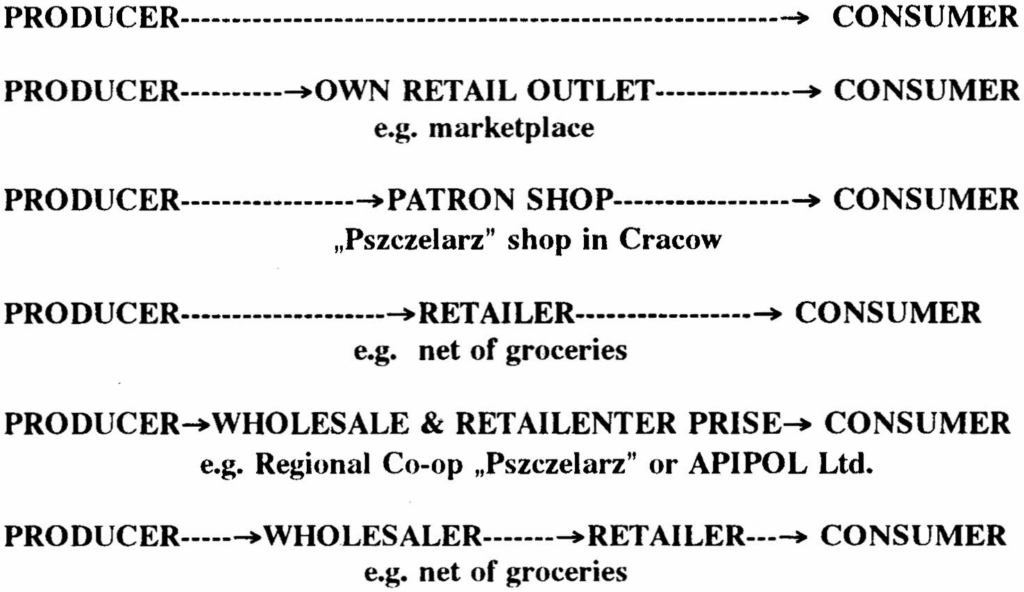
Treść ryciny (Fig. 1) — schemat złożony tekstem, linie łączników wykonane ciągami dywizów zakończonych strzałką:
PRODUCER———————————————————–→ CONSUMER
PRODUCER———-→OWN RETAIL OUTLET————-→ CONSUMER e.g. marketplace
PRODUCER—————-→PATRON SHOP—————–→ CONSUMER „Pszczelarz” shop in Cracow
PRODUCER——————-→RETAILER——————→ CONSUMER e.g. net of groceries
PRODUCER→WHOLESALE & RETAILENTER PRISE→ CONSUMER e.g. Regional Co-op „Pszczelarz” or APIPOL Ltd.
PRODUCER—–→WHOLESALER——-→RETAILER—→ CONSUMER e.g. net of groceries
Fig. 1. Channels of honey distribution in Cracow Kanały dystrybucji miodu w krakowie
Civil and commercial law companies (i.e. registered partnerships and public companies) were predominant among wholesalers who delivered honey to shops. Direct shares of co-operatives and capital companies were smaller, 20 and 10% respectively. The main factors determining the source of honey supplies for retailers, due to financial reasons, were price and localization of the wholesale company in relation to the market served. This reasoning was pointed to by nearly all shops. The choice of distribution
strona 202channel depended also on seasonality of production and consumption of honey. Retailers purchased honey mainly from beekeepers immediately after harvest. They used to buy bigger installments from wholesale companies in winter when honey sales increased considerably. The investigations have shown that groceries sell about 10 kg of honey a month, whereas speciality apiarian and herb-cultivation shops even 100 kg. Foodstuffs wholesalers averaged c.a. 2000 kg. In the analyzed shops, a great variety of different honeys was offered to clients during the whole year. However, the polyflora honey and honeydew were best available (Fig. 2).
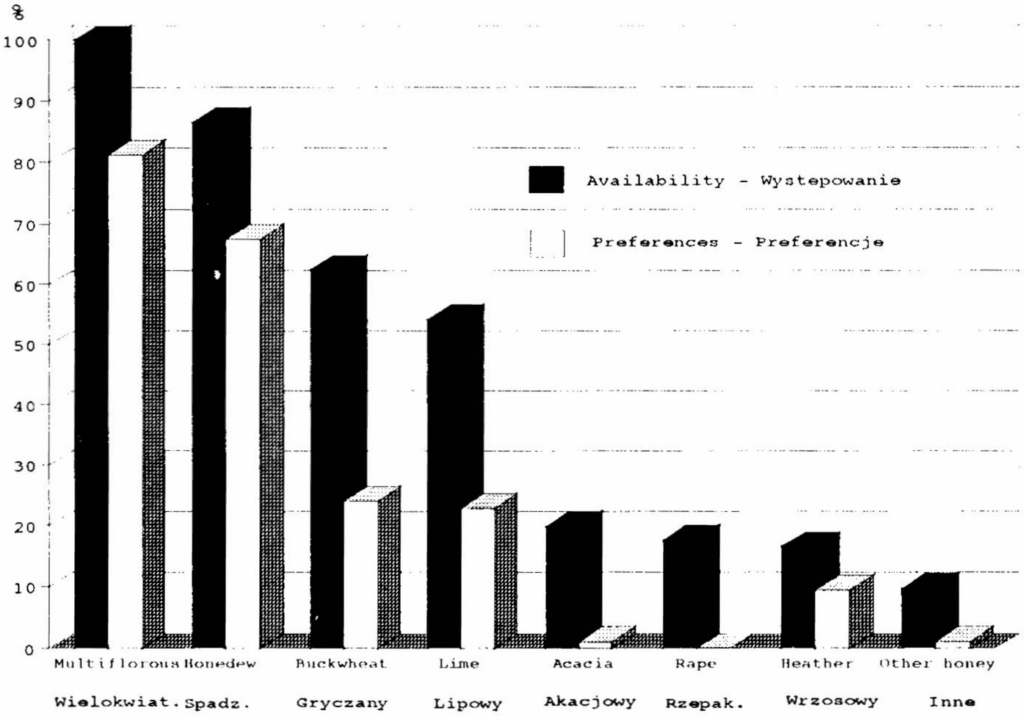
Fig. 2. Availbility of various quality honeys and consumers’ preferences in the analyzed shops Występowanie miodów oraz preferencje konsumentów w analizowanych sklepach
The trade offer matched, to a great extent honey consumers’ preferences. In retail outlets one could find from 3 to 9 sorts of honey sold in 0.25kg and 0.5kg glass jars. The greatest variety of honeys was offerred by speciality shops, e.g. „Pszczelarz”. The amount of honey sales was strictly connected with the number of sorts offered with little variety, e.g. four sorts, retail outlets sold monthly c.a. 8.5 kg of honey, with six sorts the sales averaged c.a. 25 kg. The dependence was statistically proved ( α = 0.05 , r = 0.682)
The investigated shops applied from 10 to 25% profit margin for honey. However, a great majority of retail outlets (75%) used the profit
strona 203margin lower than 20%, and consequently were selling more honey. The analyzed wholesalers used from 5 to 10% profit margin, but also a great majority applied the lower values.
Wholesale prices for 1kg of honey fluctuated considerably over the analyzed period. They ranged from 5.15 to 6.63 PLZ, while retail prices varied from 5.33 to 8.79 PLZ. The highest prices were maintained for honeydew, the lowest for rape honeys. A wide price range , e.g. up to 20% within the same sort, was connected, among others, with localization of sales place, seasonality and consumers’ demand. Honey sells better in winter months so the dealers often raise its price in this season. The level of wholesale prices depended on the size of the installment of purchased goods. Various discounts were applied. Wholesalers offered honey both in transport and omnibus packing. The packing protected the goods against harmful influence of external factors and secured its safe unloading and storing. Honey is not a commodity which demands activation of sales. Only one company advertises and promotes its wares, and sells direct through its sales representatives.
CONCLUSIONS
- The share of socialized units in honey turnover in Cracow has decreased distinctly, whereas new entrepreneurs are ascertaining fixed positions on its market.
- New subjects dealing in honey distribution are: partnerships based on commercial law, capital companies and individual beekeepers.
- An apparent differentiation in ways of honey offering, visible e.g. in the assortment policy is a characteristic feature of changing structure of honey distribution.
- Price of honey is the main factor decisive of the place of getting supplies.
- Consumers’ preferences match, to a considerable extend, both wholesale and retail offering.
- An increased supply of quality honey supported by a wider promotion would raise demand.
REFERENCES
C i c h o ń J., W i l d e J.(1996) – Konkurencyjność polskiego pszczelarstwa na rynku światowym Konkurencyjność polskiego rolnictwa i agrobiznesu na rynkach międzynarodowych. III Kongres SERiA, Olsztyn: 579-586.
G a r b a r s k i L, R u t k o w s k i J, W r z o s e k W. (1996) – Marketing. PWE, Warszawa: 359-411.
Honey: A study of major markets (1986).- ITC UNCTAD/GATT Genevea: 27-124
M a r z e c J (1996) – Wpływ marż na wielkość sprzedaży miodu w Krakowie XXXIII Naukowa Konferencja Pszczelarska. Puławy, 53-55.
P i d e k A. (1994) – Ekonomika i organizacja produkcji pszczelarskiej w Polsce Raport o stanie pszczelarstwa. Pszczeln. Tow. Nauk. Puławy: 37-48.
ORGANIZACJA ZAOPATRZENIA MIESZKAŃCÓW KRAKOWA W MIÓD
J. Marzec
Streszczenie
Lata 90-te są okresem zasadniczych zmian w strukturze polskiego rynku produktów pszczelich. Zachodzące zmiany dotyczą organizacji i funkcjonowania dystrybucji. Celem przeprowadzonych badań było dostarczenie informacji o lokalnej potencjalnej zdolności sprzedaży miodu oraz jej uwarunkowaniach w handlu hurtowym i detalicznycm w Krakowie.
Materiały informacyjne zgromadzone zostały w trakcie przeprowadzonych badań marketingowych w latach 1994 i 1995. Podstawowymi metodami uzyskiwania informacji były bezpośrednie obserwacje i ankieto-wywiady przeprowadzone z uczestnikami rynku. Badaniami objeto 192 placówki detaliczne, 20 hurtowni oraz 367 klientów sklepów.
Z badań wynika, że rola jednostek uspołecznionych w obrocie miodem wyraźnie zmalała. Źródłem zaopatrzenia dla krakowskich sklepów ogólnospożywczych były hurtownie artykułów spożywczych (59%), place targowe (23%), spółdzielnie – OSP Kraków- (10%) oraz indywidualni pszczelarze (8%). Natomiast specjalistyczne sklepy pszczelarsko-zielarskie zaopatrywały się głównie bezpośrednio u pszczelarzy (67%). Mieszkańcy Krakowa preferowali zakup miodu głównie w sklepach (85%), a w mniejszym stopniu bezpośrednio od pszczelarza (21%), czy na placach targowych (95). W okresie badań na lokalnym rynku miodu prowadziło działalność pięciu liczących się jego dostawców. Ich udział w podziale analizowanych sklepów kształtował się od 36% do 16%. Hurtownie zaopatrujące detalistów w miód to głównie spółki prawa cywilnego i handlowego. Podstawowym czynnikiem wyboru miejsca zaopatrzenia była cena miodu, a także lokalizacja hurtowni. Miesięczny poziom sprzedaży miodu wynosił w placówkach detalicznych od 10 kg do 100 kg, natomiast w hurtowniach około 2000 kg. Sklepy stosowały marże w wysokości 10-25%, podczas gdu hurtownie 5-10%. Preferencje konsumentów dotyczące gatunków miodu w większości były zgodne z ofertą handlu. Jednak zwiększona podaż miodów gatunkowych połączona z szerszą ich promocją przyczyniłaby się do wzrostu popytu. Pozion cen hurtowych 1 kg miodu był na przestrzeni analizowanego okresu bardzo zróżnicowany i kształtował się od 5,15 zł do 6,63 zł, natomiast detalicznych od 5,33 zł do 8,79 zł. Najwyższe ceny utrzymywano na miody spadziowe, a najniższe na miody rzepakowe. Duży rozrzut cen, np. 20% w obrębie tego samego gatunku, był związany m.in. z lokalizacją miejsca sprzedaży, z sezonowością zapotrzebowania konsumentów.
Slowa kluczowe: miód, dystrybucja, ogniwa, Kraków
Errata — błędy druku znalezione podczas digitalizacji
- s. 199, streszczenie: „partneships” → partnerships
- s. 199, streszczenie: „hoeny” → honey
- s. 199, streszczenie: „Consumesr” → Consumers
- s. 200: „measurment” → measurement
- s. 200: „Beekepers'” → Beekeepers’
- s. 201: „form individual” → from individual
- s. 201: „bying” → buying
- s. 201, ryc. 1: „RETAILENTER PRISE” → RETAIL ENTERPRISE
- s. 201, ryc. 1: „w krakowie” → w Krakowie
- s. 202, ryc. 2: „Honedew” → Honeydew
- s. 202, ryc. 2: „Availbility” → Availability
- s. 202: „offerred” → offered
- s. 203: „considerable extend” → considerable extent
- s. 204, piśmiennictwo: „Genevea” → Geneva
- s. 204, streszczenie: „detalicznycm” → detalicznym
- s. 204, streszczenie: „objeto” → objęto
- s. 204, streszczenie: „targowych (95)” → targowych (9%)
- s. 204, streszczenie: „gdu” → gdy
- s. 204, streszczenie: „Pozion” → Poziom
- s. 204, słowa kluczowe: „Slowa” → Słowa